
The testimony of Gedulla Menko
The translated 1958 testimony of Gedulla Menko, detailing her survival through Auschwitz and the death marches, and how hosting a member of an Israeli sports delegation years later inspired her life-changing decision to make Aliyah.
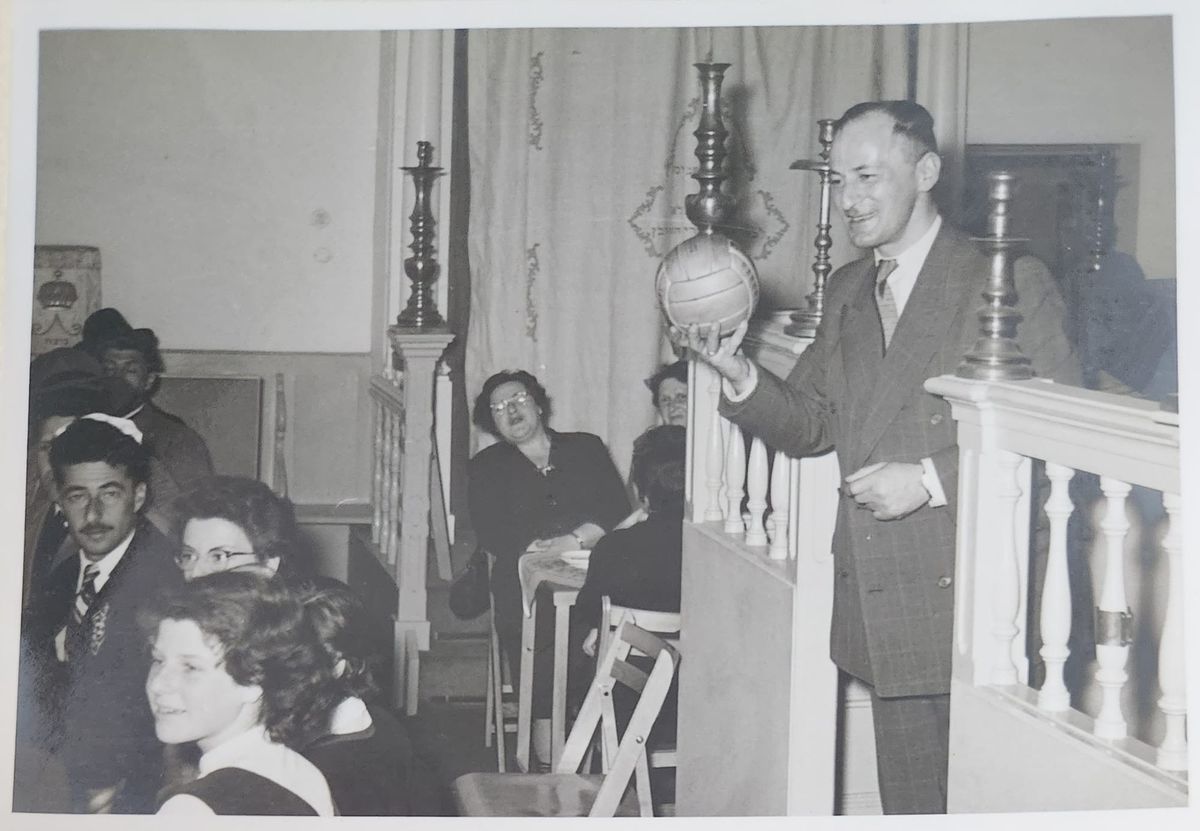
I first heard about Gedulla from Amela Shani. My daughter Tamar and I paid her a visit at her beautiful house in Rehovot. We went over photos, and she told us about the special relationship Amihud had with Gedulla. She knew Gedulla came from an orthodox Jewish home and had lost all her family in the Holocaust. Gedulla volunteered to host Amihud during Maccabi Rehovot's first visit in 1954, and he again stayed at her house in Hengelo during the second tour in 1956. Amela consulted with Ariela, Amihud's sister, about the details she remembered. The story was that the visits from Israel had an important impact on Gedulla's decision to embrace Zionism, which led her to first visit Rehovot and later make Aliyah. They remembered that she worked at Yad Vashem, married a religious man, and kept a strictly observant Jewish home until the day she died.
The story Amela told us is mostly correct. Gedulla did indeed make Aliyah in 1957, and in early 1958, she submitted a testimony about her life to Yad Vashem. She describes her life and the Jewish community around her from before the war until her Aliyah, as well as her short experience adjusting as a new immigrant in Israel. This post presents her testimony in full, followed by some additional information about her life I was able to gather. The testimony is a fascinating personal tale of her life and that of the Jewish community in Hengelo. Gedulla mentions the visits of the Israeli teams in her testimony; I've highlighted the relevant parts near the end of her testimony for those who wish to skip directly to them.
The testimony can be read directly from the Yad Vashem archive here.
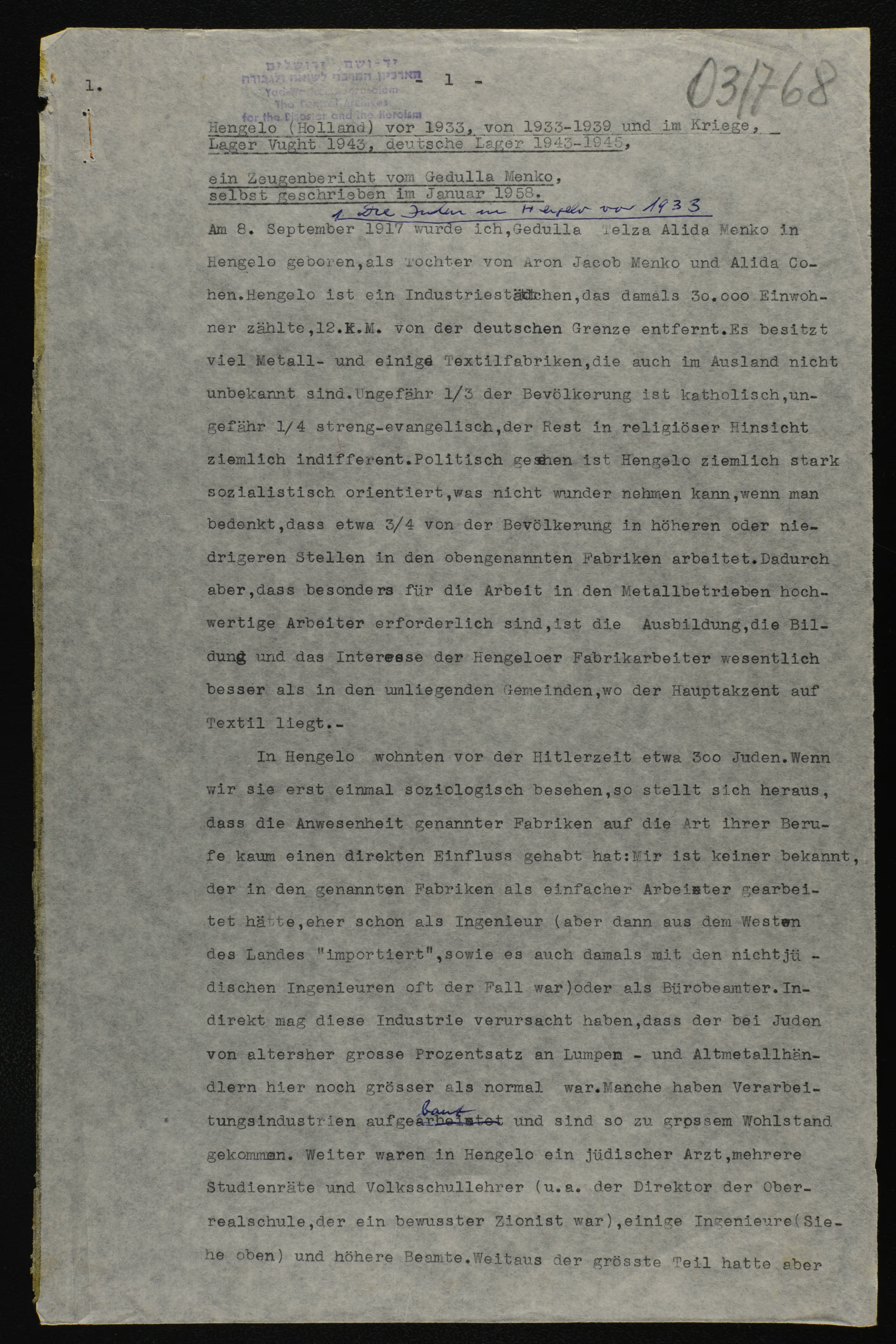
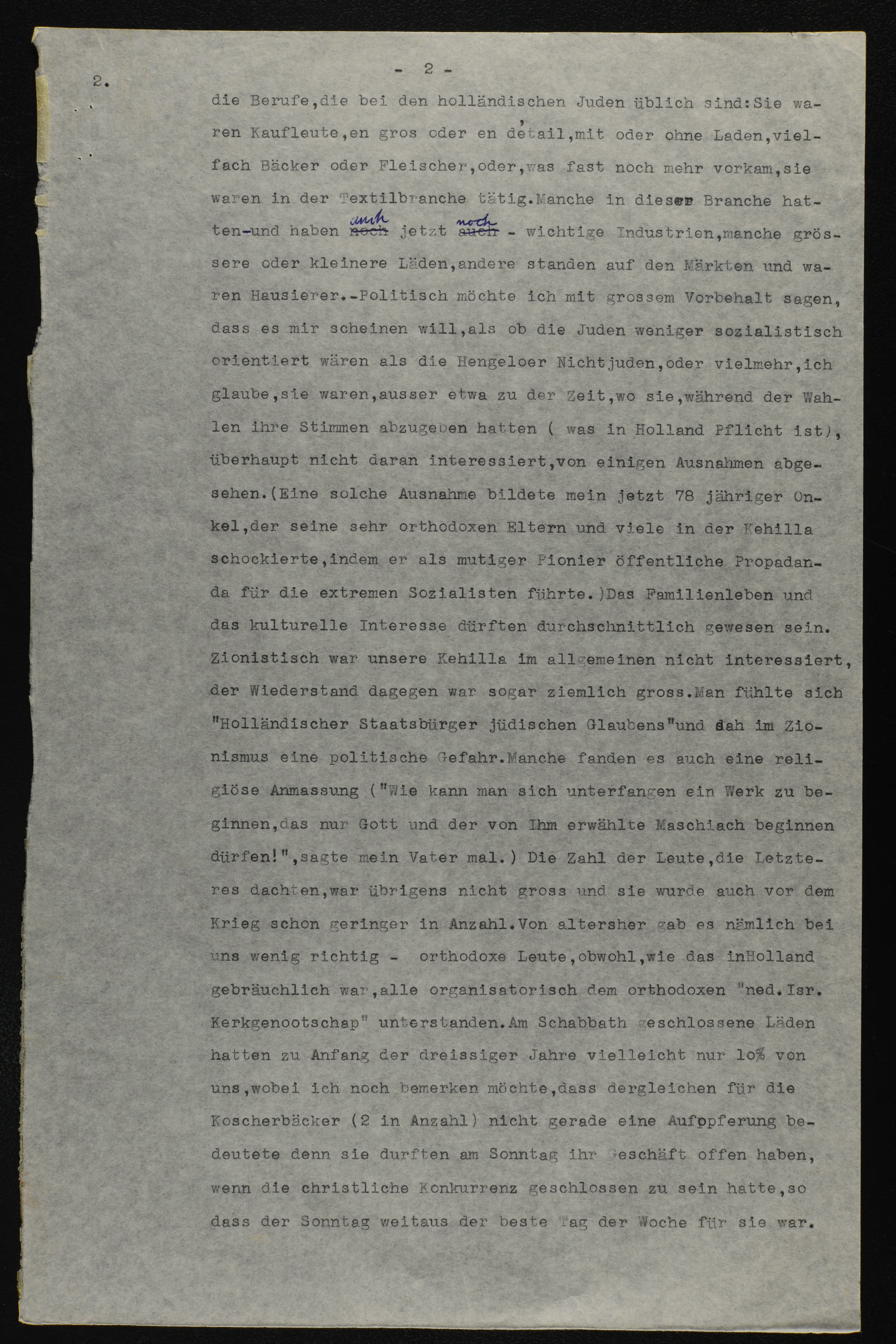
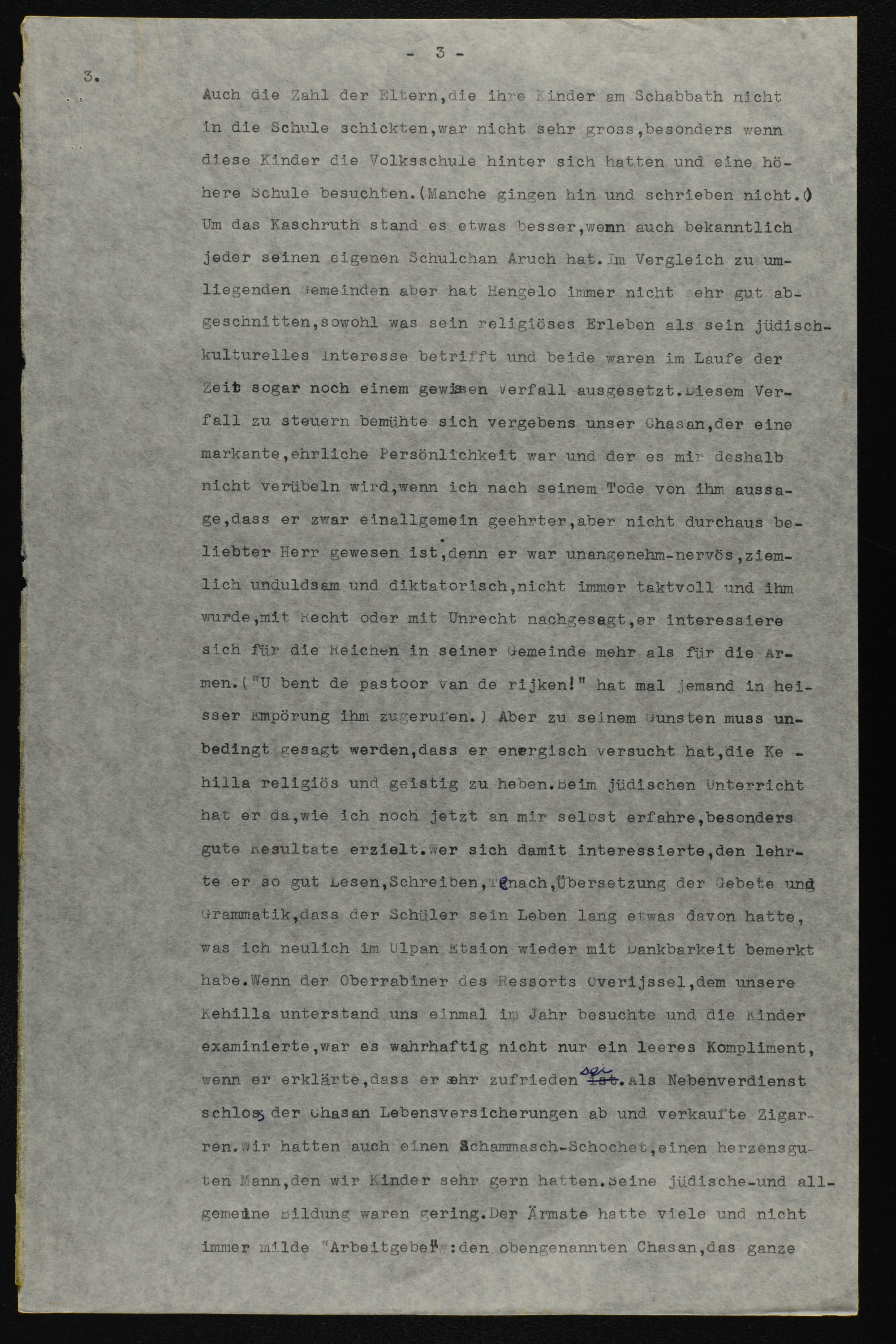
Gedula's Yad Vashem Testimony 1-9
Hengelo (Holland) before 1933, from 1933-1939 and during the war, Vught camp 1943, German camps 1943-1945.
A witness report by Gedulla Menko, written by herself in January 1958.
The Jews in Hengelo before 1933
On September 8, 1917, I, Gedulla Melza Alida Menko, was born in Hengelo, as the daughter of Aron Jacob Menko and Alida Cohen. Hengelo is a small industrial town, which at that time had 30,000 inhabitants, 12 km from the German border. It has many metal and some textile factories, which are not unknown abroad. About 1/3 of the population is Catholic, about 1/4 strictly Protestant, the rest rather indifferent in religious matters. Politically, Hengelo is quite strongly socialist-oriented, which is not surprising when you consider that about 3/4 of the population works in higher or lower positions in the above-mentioned factories. However, because highly qualified workers are required especially for the work in the metal companies, the training, education, and interests of the Hengelo factory workers are significantly better than in the surrounding communities, where the main focus is on textiles.
Before the Hitler era, about 300 Jews lived in Hengelo. If we first look at them sociologically, it turns out that the presence of these factories had hardly any direct influence on the nature of their professions: I do not know anyone who would have worked in the mentioned factories as a simple worker, rather as an engineer (but then "imported" from the west of the country, as was often the case back then with non-Jewish engineers) or as an office clerk. Indirectly, this industry may have caused the traditionally large percentage of rag and scrap metal dealers among Jews to be even larger than normal here. Some built up processing industries and thus achieved great prosperity. Furthermore, there was a Jewish doctor in Hengelo, several secondary school teachers and elementary school teachers (including the director of the secondary school, who was a conscious Zionist), some engineers (see above) and higher civil servants. By far the largest part, however, had the professions that are common among Dutch Jews: They were merchants, wholesale or retail, with or without a shop, often bakers or butchers, or, which was almost even more common, they were active in the textile industry. Some in this industry had - and also still have now - important industries, some larger or smaller shops, others stood at the markets and were peddlers. Politically, I would like to say with great reservation that it seems to me as if the Jews were less socialist-oriented than the Hengelo non-Jews, or rather, I believe they were, except perhaps at the time when they had to cast their votes during elections (which is mandatory in Holland), not interested in it at all, with a few exceptions. (One such exception was my now 78-year-old uncle, who shocked his very orthodox parents and many in the Kehilla by acting as a brave pioneer doing public propaganda for the extreme socialists.). Family life and cultural interest were probably average. Our Kehilla was generally not interested in Zionism; the resistance against it was actually quite large. People felt like "Dutch citizens of Jewish faith" and saw a political danger in Zionism. Some also found it to be religious arrogance ("How can one undertake to begin a work that only God and the Moshiach chosen by Him may begin!", my father once said.). The number of people who thought the latter was, by the way, not large and it was already decreasing in number before the war. From time immemorial, there were actually few truly orthodox people among us, although, as was customary in Holland, all were organizationally subordinate to the orthodox "ned. Isr. Kerkgenootschap" [Dutch Israelite Religious Community]. At the beginning of the 1930s, perhaps only 10% of us had shops closed on Shabbat, although I would also like to note that such a thing did not exactly mean a sacrifice for the kosher bakers (2 in number) because they were allowed to have their shop open on Sunday when the Christian competition had to be closed, so that Sunday was by far the best day of the week for them.
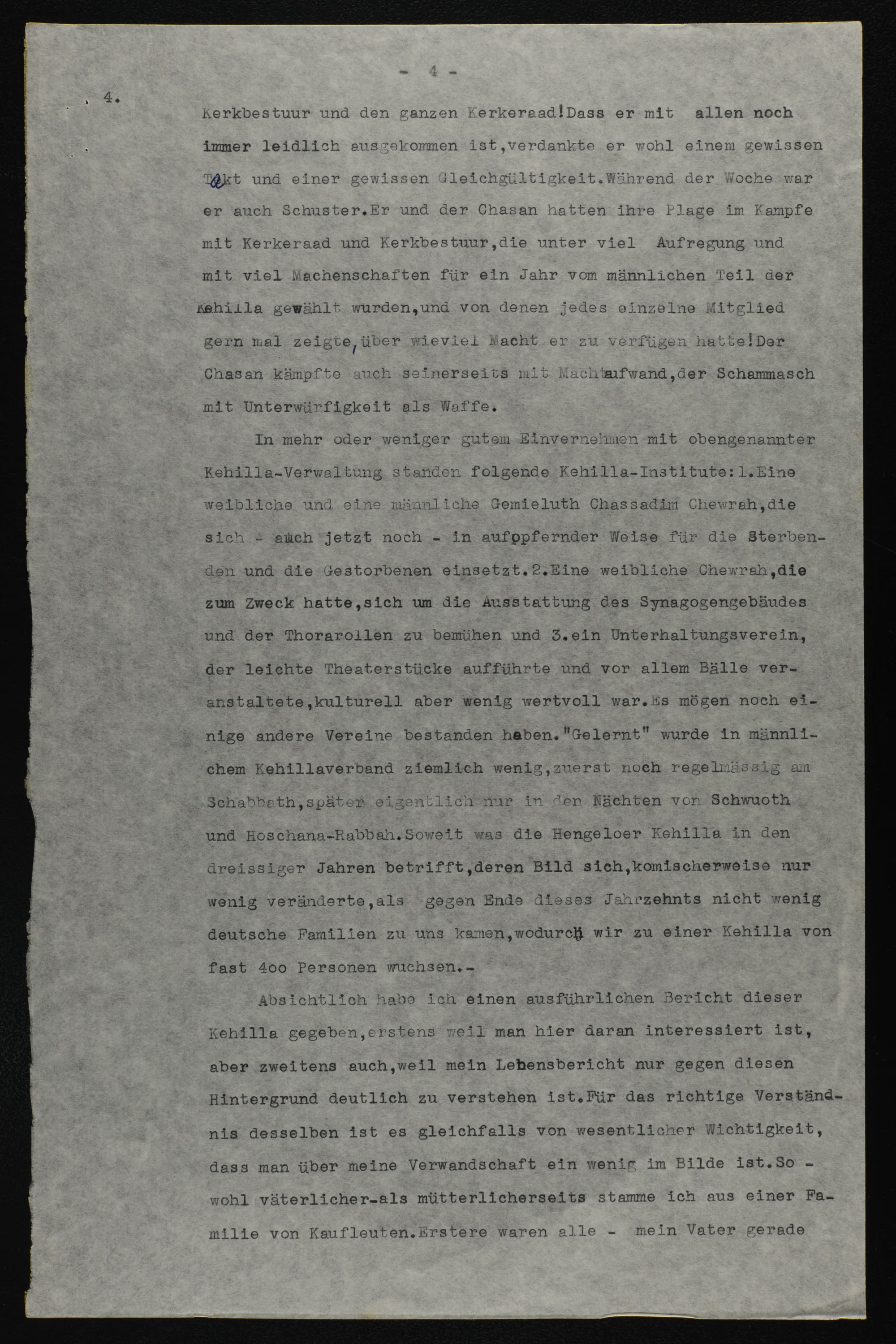
The number of parents who did not send their children to school on Shabbat was also not very large, especially when these children had finished elementary school and attended a higher school. (Some went and did not write.). As for Kashrut, things were a bit better, even though, as is well known, everyone has their own Shulchan Aruch. Compared to surrounding communities, however, Hengelo never performed very well, both regarding its religious experience and its Jewish-cultural interest, and both were even subject to a certain decline over time. Our Chazzan tried in vain to steer against this decline; he was a striking, honest personality and therefore will not hold it against me if I state about him after his death that, although he was a generally honored gentleman, he was not entirely popular, because he was unpleasantly nervous, quite intolerant and dictatorial, not always tactful and it was said of him, rightly or wrongly, that he was more interested in the rich in his congregation than in the poor. ("U bent de pastoor van de rijken!" [You are the pastor of the rich!] someone once shouted at him in hot indignation.). But in his favor, it must absolutely be said that he tried energetically to elevate the Kehilla religiously and spiritually. In Jewish instruction, as I still experience in myself today, he achieved particularly good results. Whoever was interested in it, he taught reading, writing, Tanakh, translation of prayers and grammar so well that the student had something from it for a lifetime, which I recently noticed again with gratitude in the Ulpan Etzion. When the Chief Rabbi of the Overijssel district, to whom our Kehilla was subordinate, visited us once a year and examined the children, it was truly not just an empty compliment when he declared that he was very satisfied. As a side income, the Chazzan sold life insurance and cigars. We also had a Shamash-Shochet, a very kind-hearted man whom we children liked very much. His Jewish and general education were slight. The poor man had many and not always mild "employers": the aforementioned Chazzan, the whole Kerkbestuur [Church board] and the entire Kerkeraad [Church council]!. That he still managed to get along reasonably well with everyone was probably due to a certain tact and a certain indifference. During the week he was also a shoemaker. He and the Chazzan had their troubles struggling with the Kerkeraad and Kerkbestuur, who were elected for one year by the male part of the Kehilla amidst much excitement and many machinations, and of whom every single member liked to show how much power he had at his disposal!. The Chazzan also fought on his part with a display of power, the Shamash with submissiveness as a weapon.
In more or less good agreement with the above-mentioned Kehilla administration stood the following Kehilla institutes: 1. A female and a male Gemiluth Chassadim Chevrah, which - even now - dedicates itself sacrificially to the dying and the deceased. 2. A female Chevrah, whose purpose was to look after the furnishing of the synagogue building and the Torah scrolls and 3. an entertainment club that performed light plays and above all organized balls, but was of little cultural value. There may have been a few other clubs. In the male Kehilla association, fairly little "learning" took place, at first still regularly on Shabbat, later actually only on the nights of Shavuot and Hoshana Rabbah. So much for the Hengelo Kehilla in the 1930s, the image of which, funnily enough, changed only slightly when, towards the end of this decade, quite a few German families came to us, causing us to grow into a Kehilla of almost 400 people.
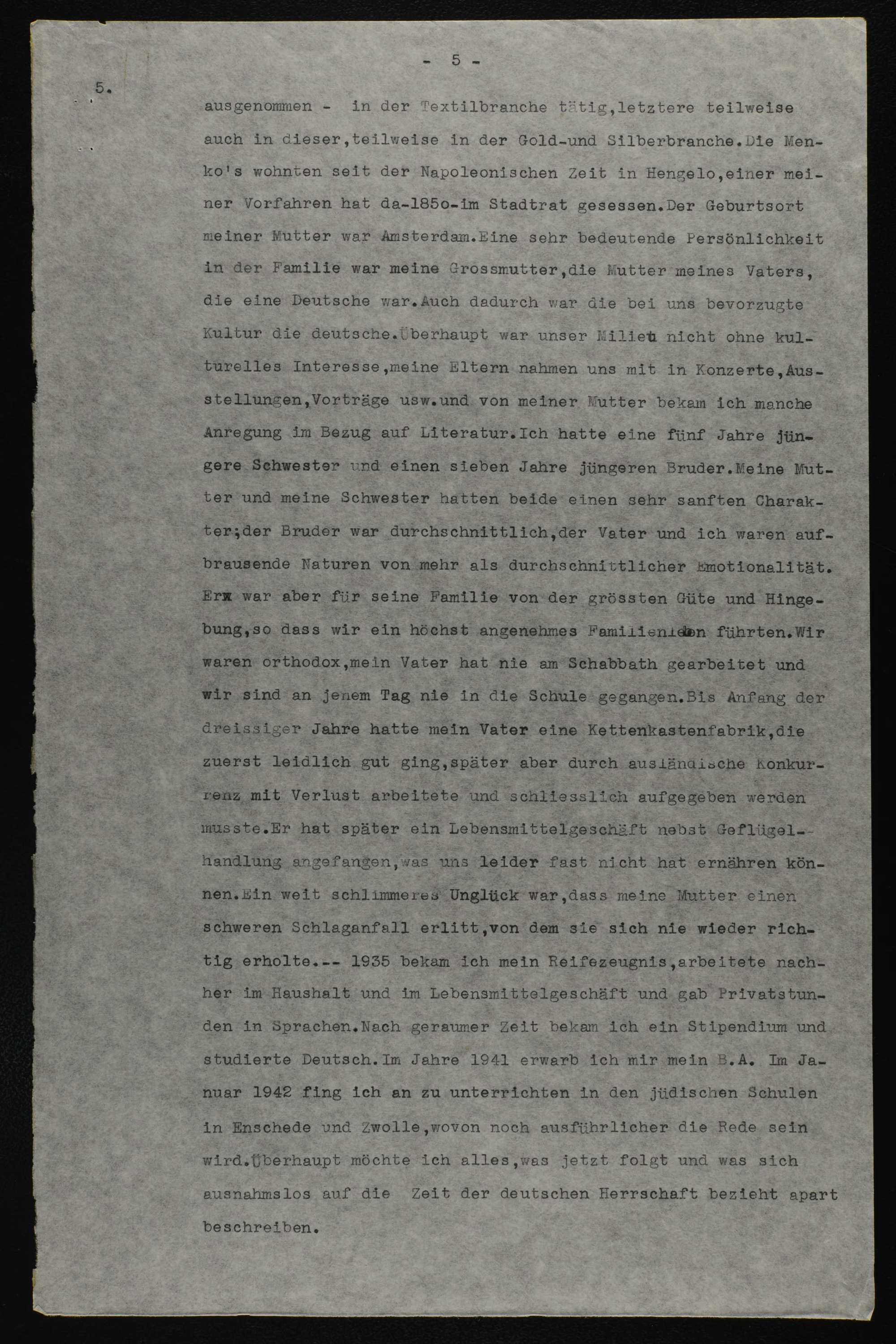
I intentionally gave a detailed report of this Kehilla, firstly because people here are interested in it, but secondly also because my life report can only be clearly understood against this background. For its correct understanding, it is also of essential importance to know a little bit about my relatives. On both my father's and my mother's side, I come from a family of merchants. The former were all - my father exactly excepted - active in the textile industry, the latter partly in this, partly in the gold and silver industry. The Menkos had lived in Hengelo since the Napoleonic era; one of my ancestors sat on the city council there - in 1850. My mother's birthplace was Amsterdam. A very significant personality in the family was my grandmother, my father's mother, who was a German. This was also why the preferred culture in our home was German. In general, our milieu was not without cultural interest; my parents took us to concerts, exhibitions, lectures, etc., and from my mother I received many inspirations regarding literature. I had a sister five years younger and a brother seven years younger. My mother and sister both had a very gentle character; the brother was average, my father and I were quick-tempered natures of more than average emotionality. But he was of the greatest kindness and devotion for his family, so that we led a highly pleasant family life. We were orthodox, my father never worked on Shabbat and we never went to school on that day. Until the beginning of the thirties, my father had a chain case factory, which at first went reasonably well, but later operated at a loss due to foreign competition and finally had to be given up. He later started a grocery store along with a poultry shop, which unfortunately could barely feed us. A far worse misfortune was that my mother suffered a severe stroke, from which she never really recovered.... In 1935 I got my high school diploma, afterwards worked in the household and in the grocery store and gave private lessons in languages. After some time, I got a scholarship and studied German. In 1941 I earned my B.A.. In January 1942 I started teaching in the Jewish schools in Enschede and Zwolle, which will be discussed in more detail later. In general, I would like to describe everything that follows now and which refers without exception to the time of German rule separately.
The Jews in Hengelo 1933-1940
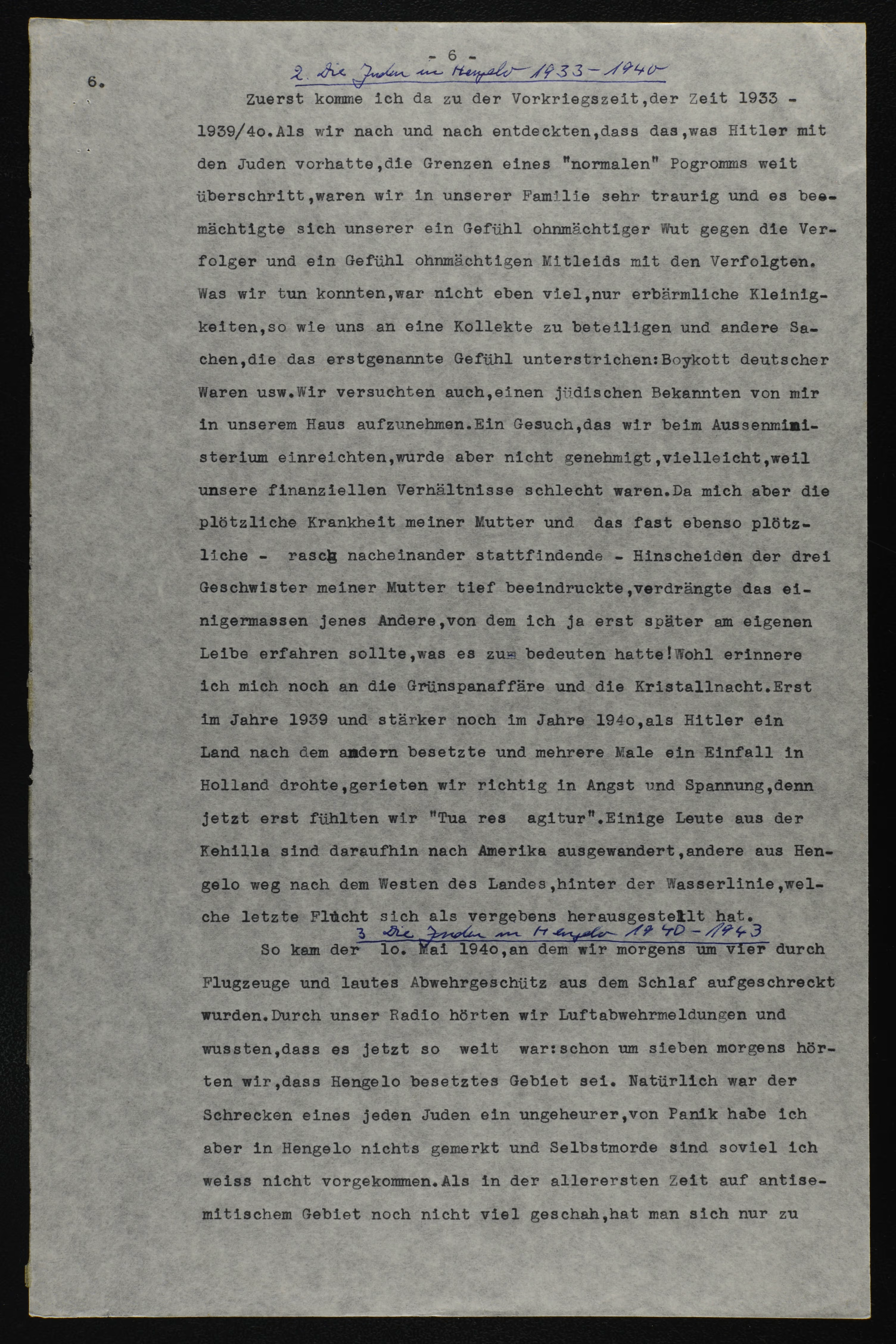
First I come to the pre-war period, the period 1933-1939/40. When we gradually discovered that what Hitler intended for the Jews went far beyond the boundaries of a "normal" pogrom, we in our family were very sad and a feeling of impotent rage against the persecutors and a feeling of impotent pity for the persecuted took hold of us. What we could do was not exactly much, only pitiful little things, like taking part in a collection and other things that underlined the former feeling: boycotting German goods, etc.. We also tried to take in a Jewish acquaintance of mine in our house. However, a petition we submitted to the Ministry of Foreign Affairs was not approved, perhaps because our financial circumstances were bad. But since the sudden illness of my mother and the almost equally sudden - occurring in rapid succession - passing of my mother's three siblings impressed me deeply, it somewhat suppressed that other thing, of which I would only later experience firsthand what it meant!. I do still remember the Grynszpan affair and Kristallnacht. Only in 1939 and even more strongly in 1940, as Hitler occupied one country after another and threatened an invasion of Holland several times, did we really get into fear and tension, because only now did we feel "Tua res agitur" [Your interests are at stake]. Some people from the Kehilla emigrated to America as a result, others away from Hengelo to the west of the country, behind the waterline, which latter flight turned out to be in vain.
The Jews in Hengelo 1940-1943
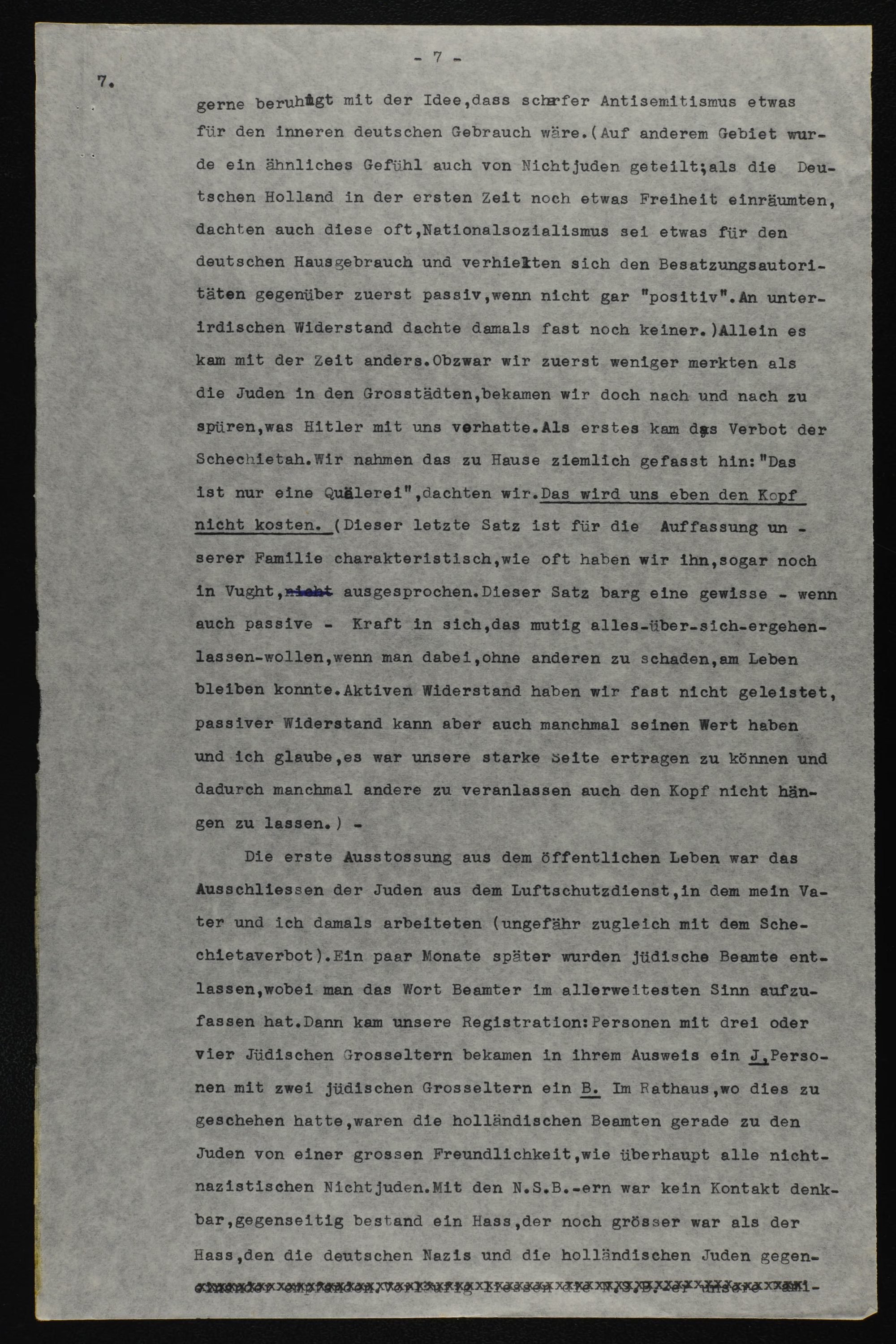
So came May 10, 1940, when we were startled out of sleep at four in the morning by airplanes and loud anti-aircraft guns. Through our radio we heard anti-aircraft reports and knew that the time had now come: already at seven in the morning we heard that Hengelo was occupied territory. Of course, the terror of every Jew was immense, but I didn't notice any panic in Hengelo and suicides did not occur as far as I know. When in the very first time not much happened yet in the anti-Semitic area, people just gladly calmed down with the idea that sharp anti-Semitism was something for internal German use. (In another area, a similar feeling was also shared by non-Jews; when the Germans still granted Holland some freedom at first, these too often thought National Socialism was something for German domestic use and behaved passively towards the occupation authorities at first, if not even "positively". Almost no one thought of underground resistance at that time.). But over time, things turned out differently. Although we noticed less at first than the Jews in the big cities, we gradually felt what Hitler had in store for us. First came the ban on Shechita [ritual slaughter]. We took it quite calmly at home: "That's just a torment", we thought. That just won't cost us our heads.. (This last sentence is characteristic of our family's attitude; how often did we say it, even in Vught. This sentence harbored a certain - albeit passive - strength, the courage to want to let everything happen to oneself, if one could stay alive in the process without harming others. We offered almost no active resistance, but passive resistance can also sometimes have its value and I believe it was our strong point to be able to endure and thereby sometimes cause others not to let their heads hang down either.)
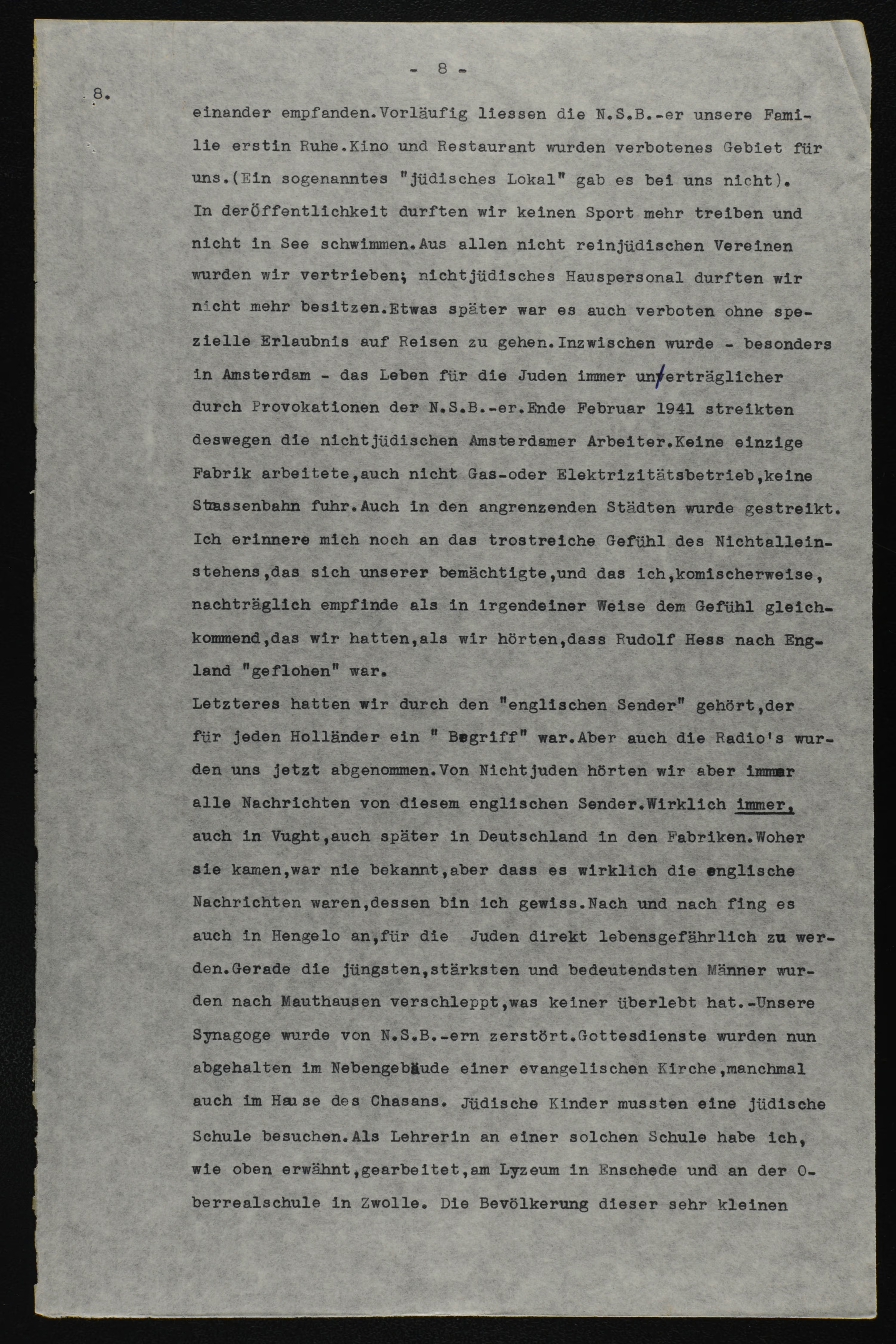
The first expulsion from public life was the exclusion of Jews from the air raid protection service, in which my father and I worked at the time (roughly simultaneously with the Shechita ban). A few months later, Jewish civil servants were dismissed, whereby the word civil servant is to be understood in the broadest possible sense. Then came our registration: persons with three or four Jewish grandparents received a J in their identity card, persons with two Jewish grandparents a B. At the town hall, where this had to be done, the Dutch officials were particularly kind to the Jews, as were all non-Nazi non-Jews in general. With the N.S.B. members, no contact was conceivable, a mutual hatred existed that was even greater than the hatred that the German Nazis and the Dutch Jews felt towards each other. For the time being, the N.S.B. members left our family alone. Cinemas and restaurants became forbidden territory for us. (There was no so-called "Jewish locale" in our town).. We were no longer allowed to do sports in public or swim in lakes. We were driven out of all non-purely Jewish clubs; we were no longer allowed to employ non-Jewish domestic staff. A little later it was also forbidden to travel without special permission. In the meantime - especially in Amsterdam - life for Jews became increasingly unbearable due to provocations by the N.S.B. members. At the end of February 1941, the non-Jewish Amsterdam workers went on strike because of this. Not a single factory worked, neither did gas or electricity plants, no trams ran. There were also strikes in the neighboring cities. I still remember the comforting feeling of not being alone that took hold of us, and which, funnily enough, I in retrospect feel is somehow equivalent to the feeling we had when we heard that Rudolf Hess had "fled" to England.
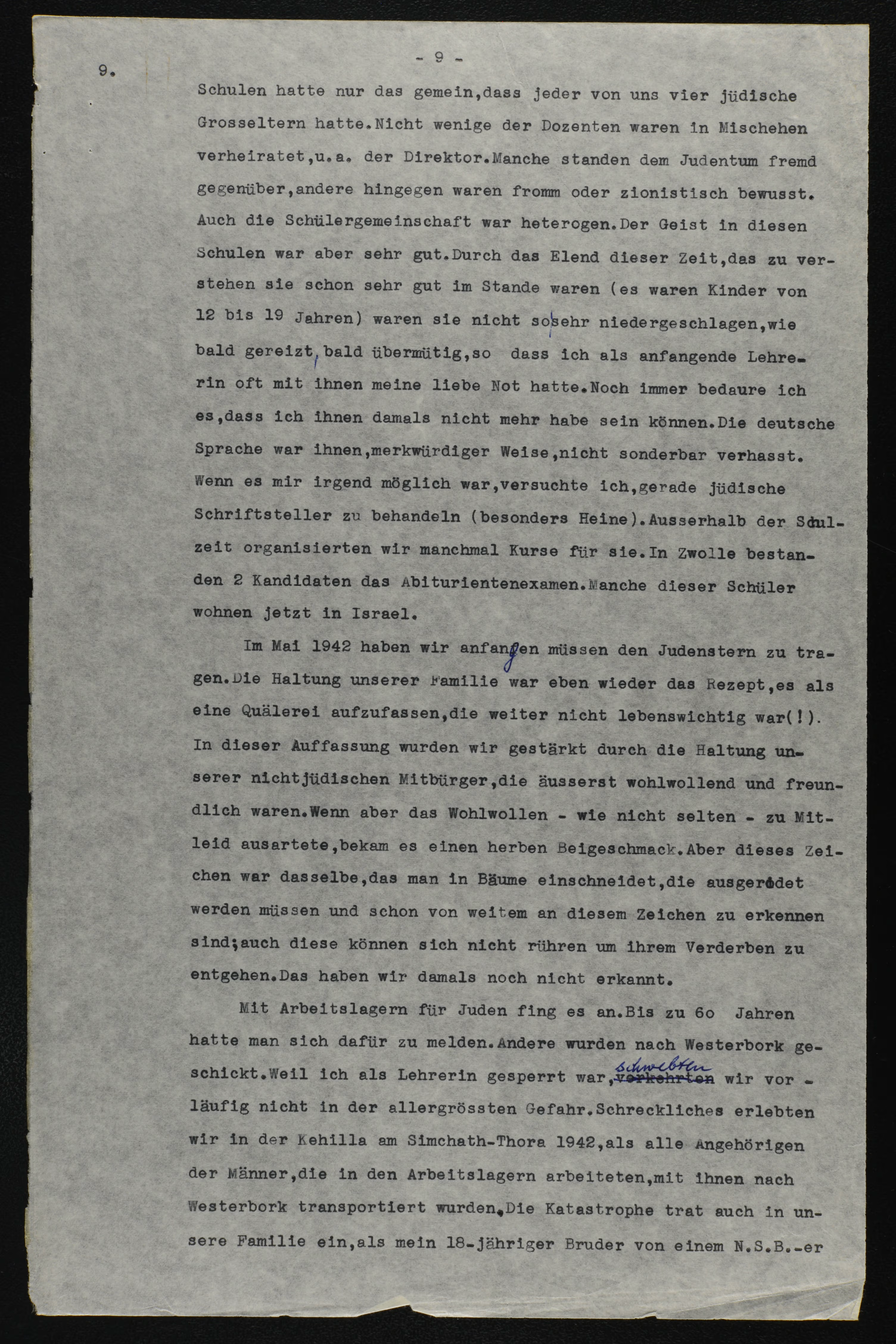
We had heard the latter through the "English station," which was an "institution" for every Dutchman. But our radios were now taken away from us as well. However, we always heard all the news from this English station from non-Jews. Really always, also in Vught, also later in Germany in the factories. Where they came from was never known, but I am certain that it really was the English news. Gradually it started to become directly life-threatening for Jews in Hengelo as well. Specifically the youngest, strongest and most significant men were deported to Mauthausen, which no one survived. -Our synagogue was destroyed by N.S.B. members. Services were now held in the outbuilding of a Protestant church, sometimes also in the Chazzan's house. Jewish children had to attend a Jewish school. As mentioned above, I worked as a teacher at such a school, at the Lyceum in Enschede and at the secondary school in Zwolle. The population of these very small schools only had in common that each of us had four Jewish grandparents. Quite a few of the lecturers were married in mixed marriages, including the director. Some were alienated from Judaism, others, however, were pious or Zionistically aware. The student body was also heterogeneous. The spirit in these schools was very good, though. Through the misery of this time, which they were already very capable of understanding (they were children from 12 to 19 years old), they were not so much depressed as sometimes irritable, sometimes high-spirited, so that as a beginning teacher I often had a hard time with them. I still regret that I could not have been more to them back then. The German language was, strangely enough, not particularly hated by them. Whenever it was at all possible for me, I tried to treat precisely Jewish writers (especially Heine). Outside of school hours, we sometimes organized courses for them. In Zwolle, 2 candidates passed the final high school exams (Abitur). Some of these students now live in Israel.
In May 1942 we had to start wearing the yellow star. The attitude of our family was again the recipe to understand it as a torment that was otherwise not life-threatening(!). In this view we were strengthened by the attitude of our non-Jewish fellow citizens, who were extremely benevolent and friendly. But when the benevolence - as happened not infrequently - degenerated into pity, it got a bitter aftertaste. But this sign was the same one that is cut into trees that have to be cleared and can be recognized from afar by this sign; they too cannot move to escape their ruin. We had not recognized that back then.
It started with labor camps for Jews. Men up to 60 years of age had to report for them. Others were sent to Westerbork. Because I was exempt as a teacher, we were not in the greatest danger for the time being. We experienced terrible things in the Kehilla on Simchat Torah 1942, when all relatives of the men working in the labor camps were transported with them to Westerbork. The catastrophe also entered our family when my 18-year-old brother was taken away by an N.S.B. member...
Gedula's Yad Vashem Testimony 10-18
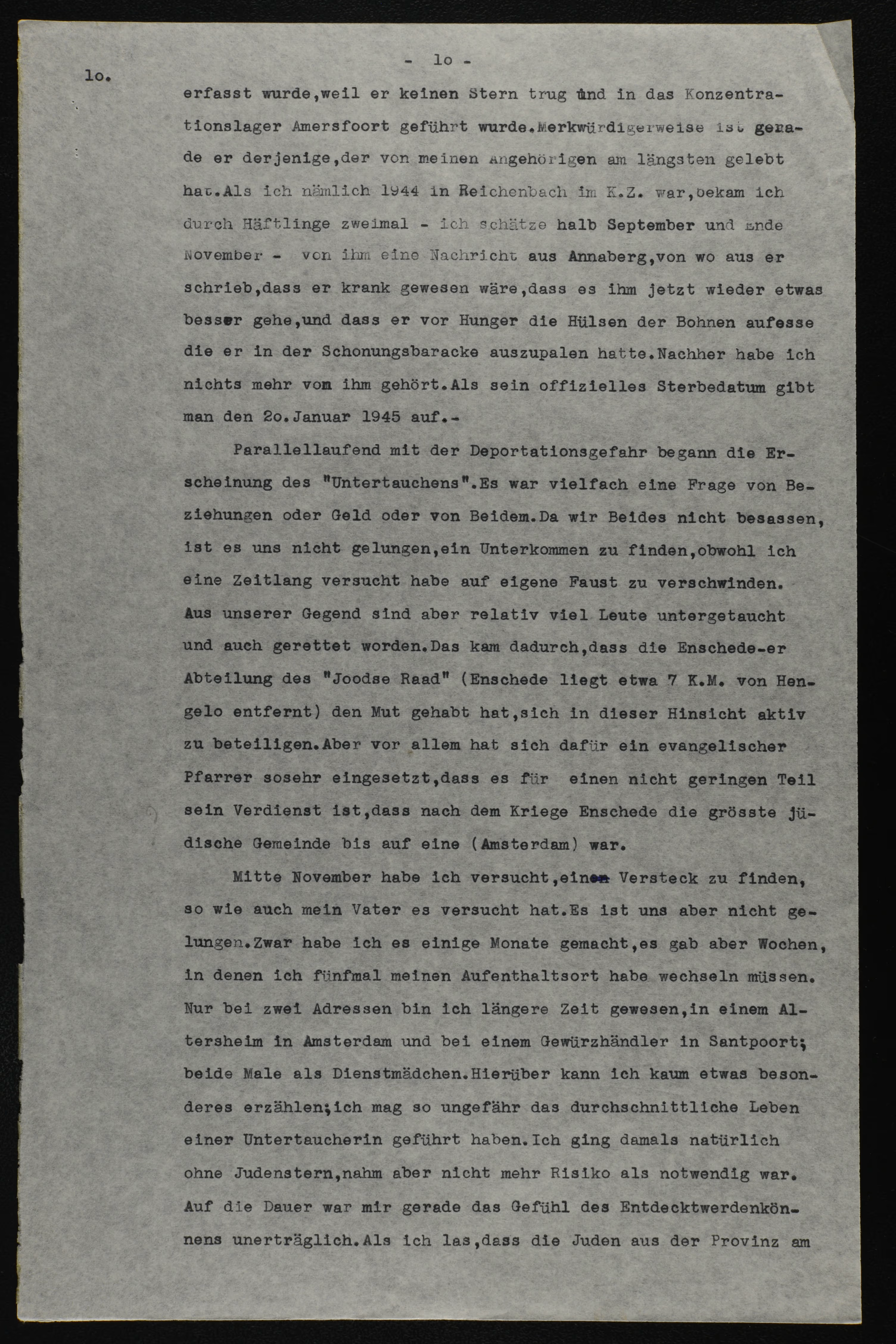
...was apprehended because he did not wear a star, and was taken to the Amersfoort concentration camp. Strangely enough, he is the one among my relatives who lived the longest. Namely, when I was in the concentration camp in Reichenbach in 1944, I received a message from him twice through prisoners - I estimate mid-September and end of November - from Annaberg, from where he wrote that he had been sick, that he was feeling a bit better now, and that out of hunger he was eating the pods of the beans that he had to shell in the convalescence barrack. After that, I never heard from him again. His official date of death is listed as January 20, 1945.
Running parallel to the danger of deportation began the phenomenon of "going into hiding" [Untertauchen]. It was often a matter of connections or money, or both. Since we possessed neither, we did not succeed in finding a place to stay, although I tried for a while to disappear on my own. However, relatively many people from our area went into hiding and were also saved. This was due to the fact that the Enschede branch of the "Joodse Raad" [Jewish Council] (Enschede is about 7 km from Hengelo) had the courage to actively participate in this regard. But above all, a Protestant pastor worked so hard for this that it is in no small part to his credit that after the war Enschede had the largest Jewish community, save for one (Amsterdam).
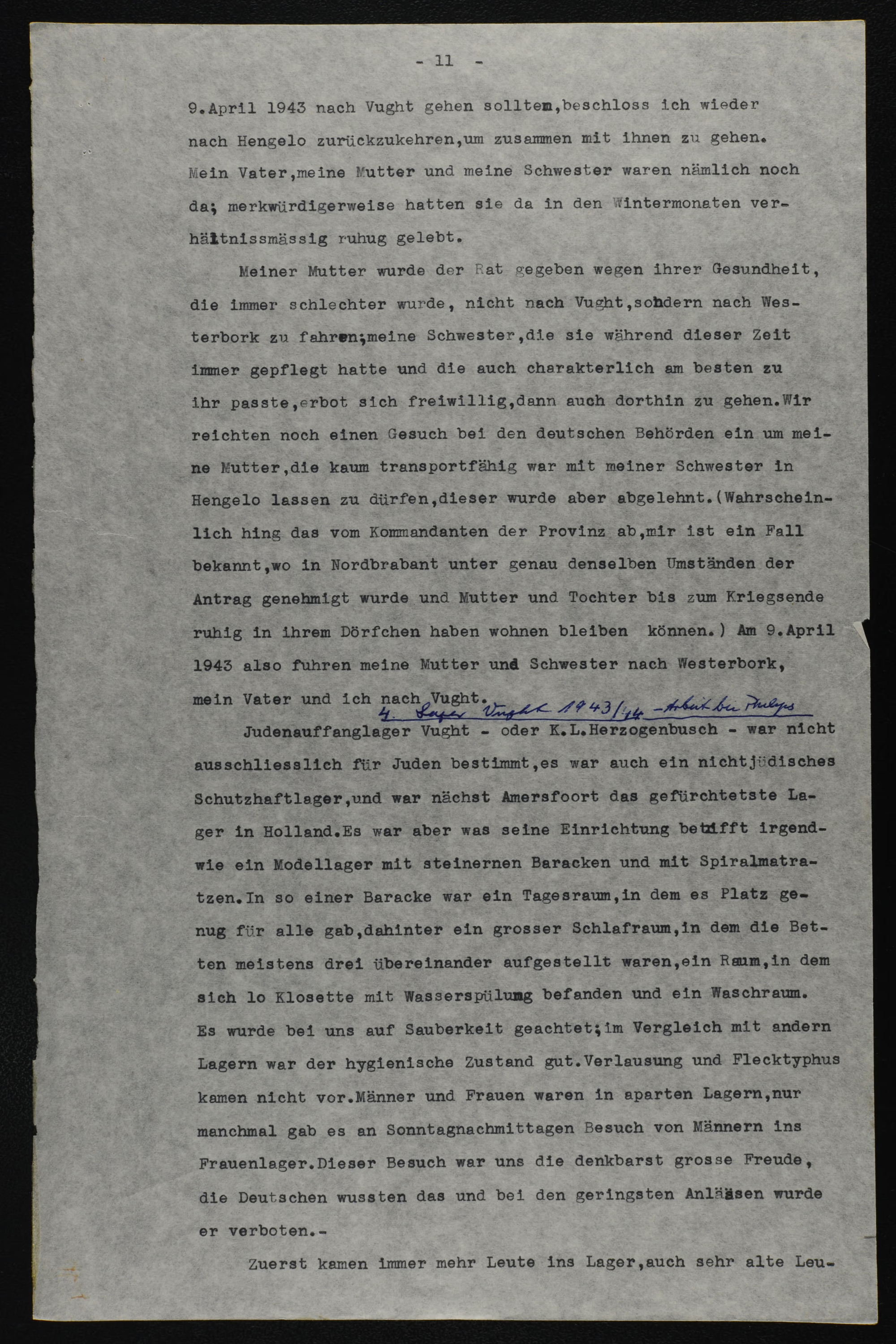
In mid-November I tried to find a hiding place, just as my father had tried. But we did not succeed. I did do it for a few months, but there were weeks in which I had to change my location five times. I was only at two addresses for a longer period of time: in an old age home in Amsterdam and with a spice merchant in Santpoort; both times as a maid. I can hardly tell you anything special about this; I probably led roughly the average life of a person in hiding. At that time I naturally went without a Jewish star, but did not take more risks than was necessary. In the long run, the feeling of possibly being discovered was simply unbearable for me. When I read that the Jews from the province on April 9, 1943, were to go to Vught, I decided to return to Hengelo in order to go together with them. My father, my mother, and my sister were namely still there; strangely enough, they had lived relatively quietly there during the winter months.
Because of her health, which was getting worse and worse, my mother was advised not to travel to Vught, but to Westerbork; my sister, who had always cared for her during this time and who also suited her best in character, volunteered to go there as well. We submitted a petition to the German authorities to be allowed to leave my mother, who was hardly fit for transport, with my sister in Hengelo, but this was rejected. (This probably depended on the commander of the province; I know of a case where the application was approved under exactly the same circumstances in North Brabant and the mother and daughter were able to continue living quietly in their small village until the end of the war.). So on April 9, 1943, my mother and sister traveled to Westerbork, my father and I to Vught.
Camp Vught 1943/44 - Work at Philips
The Jewish transit camp Vught - or K.L. Herzogenbusch - was not intended exclusively for Jews; it was also a non-Jewish protective custody camp and, next to Amersfoort, the most feared camp in Holland. However, in terms of its facilities, it was somewhat of a model camp with stone barracks and spiral mattresses. In such a barrack there was a day room in which there was enough space for everyone, behind it a large sleeping room in which the beds were mostly stacked three high, a room containing 10 flush toilets, and a washroom. Attention was paid to cleanliness among us; compared to other camps, the hygienic condition was good. Lice infestation and typhus did not occur. Men and women were in separate camps, only sometimes on Sunday afternoons were there visits from men into the women's camp. This visit was the greatest conceivable joy for us; the Germans knew that and at the slightest provocation it was forbidden.
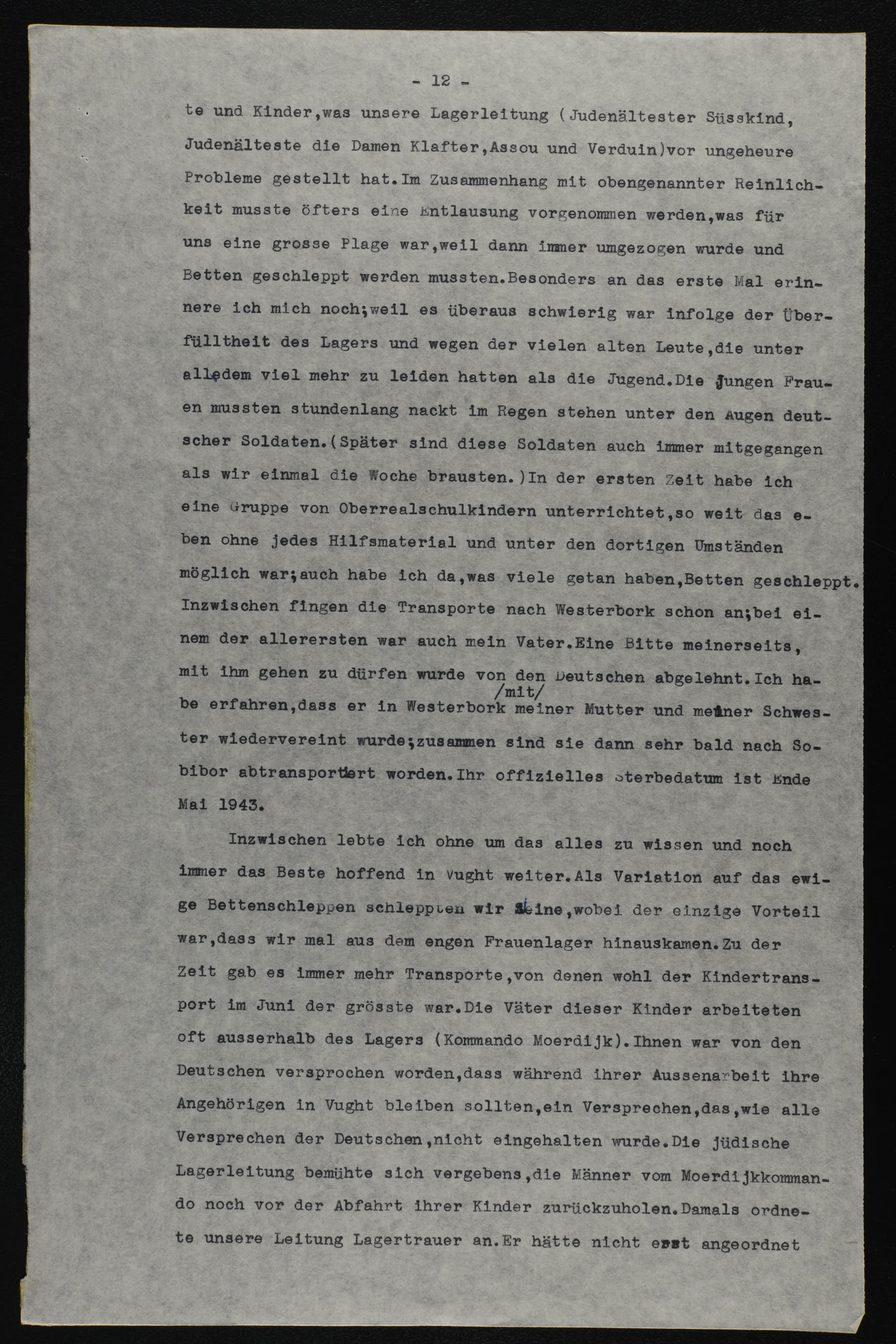
At first, more and more people came into the camp, including very old people and children, which presented our camp leadership (Jewish Elder Süsskind, Jewish Elders the ladies Klafter, Assou, and Verduin) with immense problems. In connection with the aforementioned cleanliness, a delousing often had to be carried out, which was a great plague for us, because then people always had to move and beds had to be dragged. I still remember the first time in particular; because it was extremely difficult due to the overcrowding of the camp and because of the many old people, who had to suffer much more under all this than the youth. The young women had to stand naked in the rain for hours under the eyes of German soldiers. (Later, these soldiers also always came along when we showered once a week.). In the early days I taught a group of secondary school children, as far as that was possible without any teaching materials and under the local circumstances; I also dragged beds there, as many did. Meanwhile, the transports to Westerbork were already beginning; my father was on one of the very first. A request on my part to be allowed to go with him was denied by the Germans. I found out that he was reunited with my mother and my sister in Westerbork; together they were then transported off to Sobibor very soon after. Their official date of death is the end of May 1943.
Meanwhile, without knowing all this and still hoping for the best, I continued to live in Vught. As a variation on the eternal bed-dragging, we dragged stones, the only advantage of which was that we finally got out of the cramped women's camp. At the time, there were more and more transports, of which the children's transport in June was probably the largest. The fathers of these children often worked outside the camp (Kommando Moerdijk). They had been promised by the Germans that their relatives would remain in Vught while they worked outside, a promise that, like all promises of the Germans, was not kept. The Jewish camp leadership tried in vain to bring the men of the Moerdijk commando back before their children departed. At that time, our leadership ordered camp mourning. He wouldn't have needed to order it first.
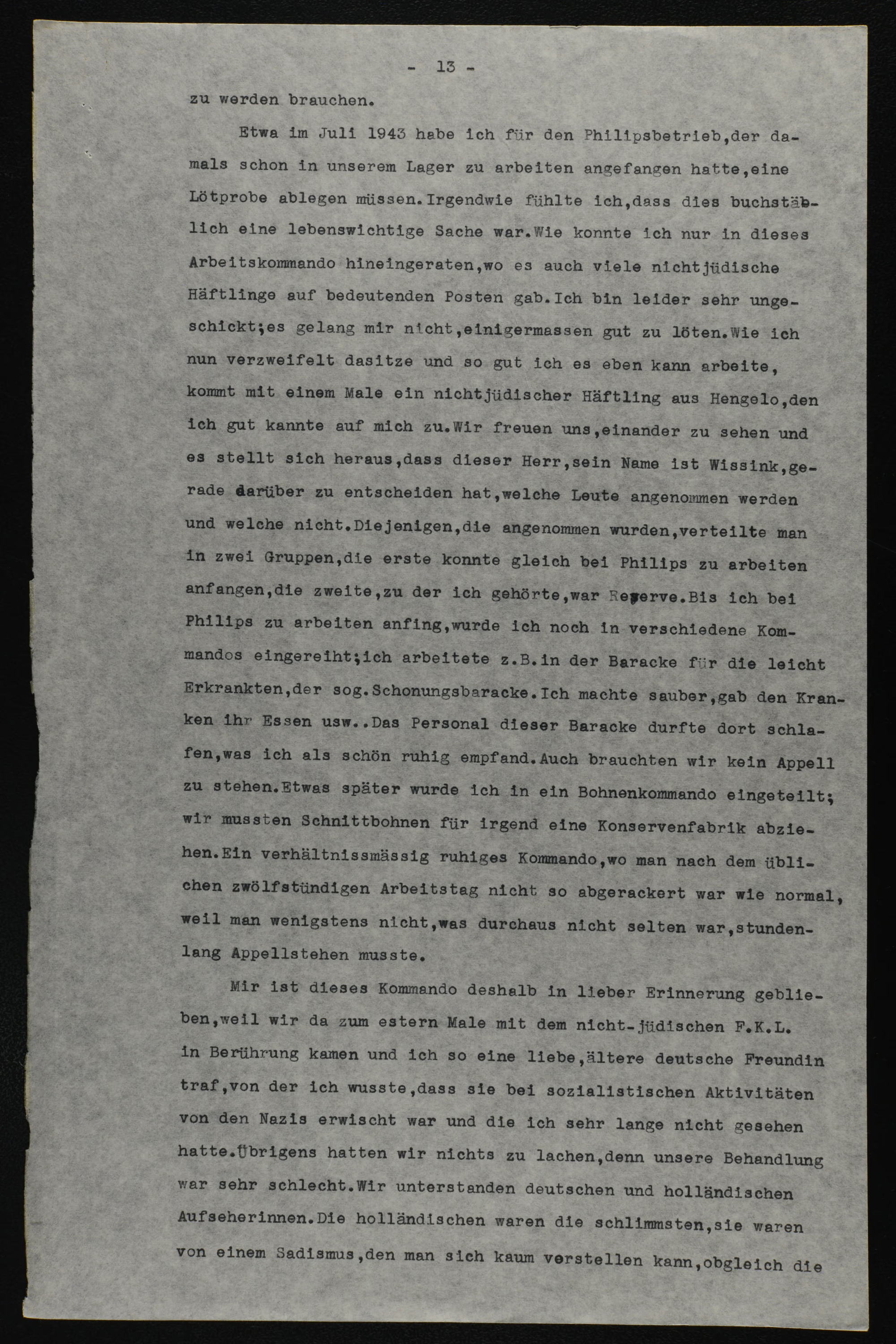
Around July 1943, I had to take a soldering test for the Philips company, which had already started operating in our camp at that time. Somehow I felt that this was literally a matter of life and death. How could I only get into this labor detail, where there were also many non-Jewish prisoners in significant positions. Unfortunately, I am very clumsy; I did not succeed in soldering reasonably well. As I sat there in despair, working as best I can, a non-Jewish prisoner from Hengelo whom I knew well suddenly approached me. We were happy to see each other and it turned out that this gentleman, his name is Wissink, was precisely the one to decide who was accepted and who was not. Those who were accepted were divided into two groups: the first could start working at Philips right away, the second, to which I belonged, was reserve. Before I started working at Philips, I was placed into various details; for example, I worked in the barrack for the mildly ill, the so-called convalescence barrack. I cleaned, gave the patients their food, etc.. The staff of this barrack were allowed to sleep there, which I found nice and quiet. We also didn't have to stand for roll call. A little later I was assigned to a bean detail; we had to string beans for some canning factory. A relatively quiet detail, where one wasn't quite as exhausted as normal after the usual twelve-hour workday, because at least one didn't have to stand for hours at roll call, which was not at all uncommon.
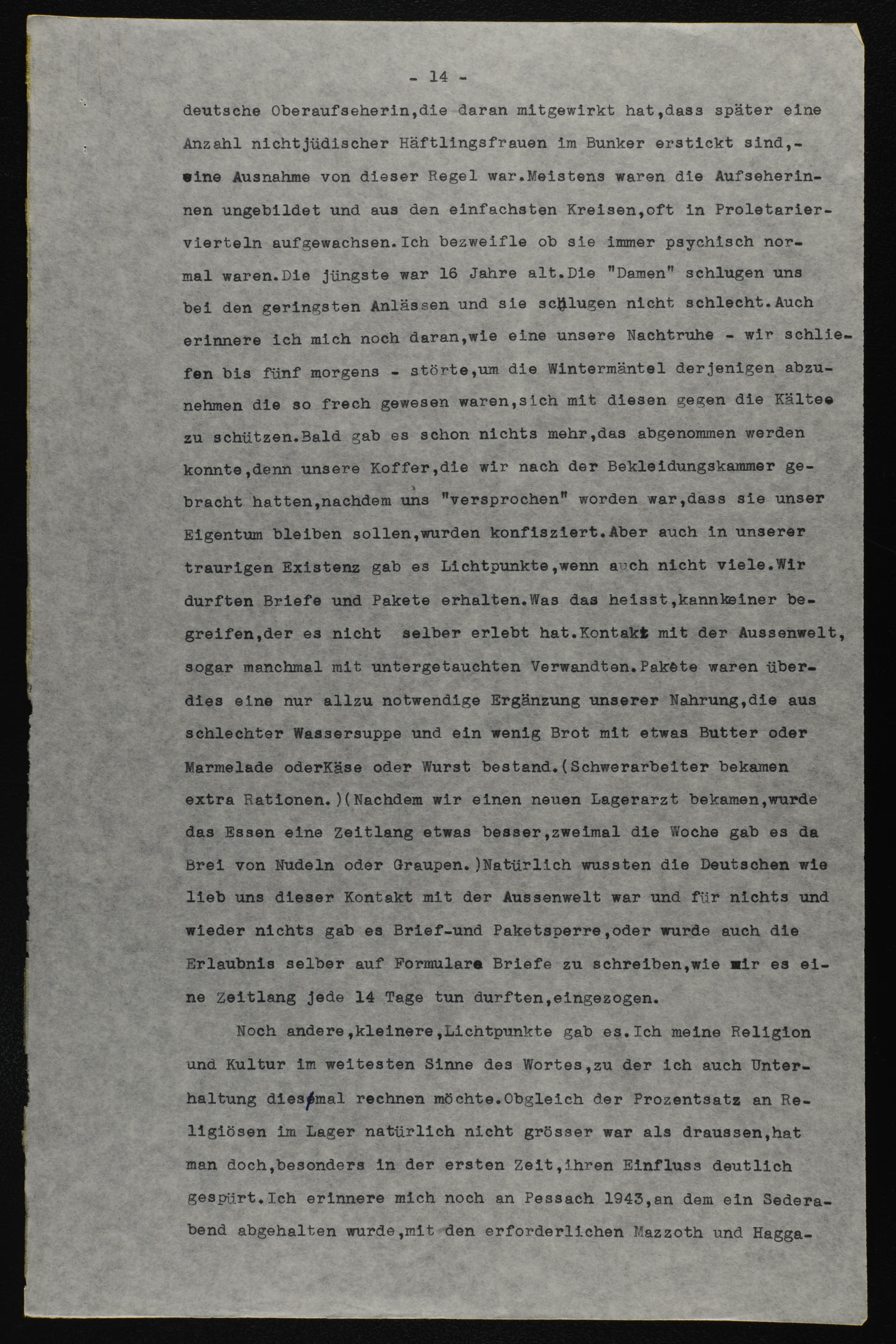
I retain fond memories of this detail because it was there that we first came into contact with the non-Jewish F.K.L. [Women's Concentration Camp], and thus I met a dear, older German friend of whom I knew that she had been caught by the Nazis during socialist activities and whom I hadn't seen for a very long time. Otherwise, we had nothing to laugh about, because our treatment was very bad. We were subordinated to German and Dutch female guards. The Dutch ones were the worst; they were possessed of a sadism that one can hardly imagine, although the German head guard, who was involved in suffocating a number of non-Jewish female prisoners in the bunker later on, was an exception to this rule. Mostly, the female guards were uneducated and had grown up in the simplest circles, often in proletarian neighborhoods. I doubt whether they were always psychologically normal. The youngest was 16 years old. The "ladies" beat us on the slightest provocation and they hit hard. I also still remember how one disturbed our night's rest - we slept until five in the morning - to take away the winter coats of those who had been so impudent as to protect themselves against the cold with them. Soon there was nothing left that could be taken away, because our suitcases, which we had brought to the clothing room after being "promised" that they would remain our property, were confiscated. But even in our sad existence there were bright spots, even if not many. We were allowed to receive letters and packages. What that means, no one can grasp who has not experienced it themselves. Contact with the outside world, sometimes even with relatives in hiding. Packages were moreover an all too necessary supplement to our food, which consisted of bad water soup and a little bread with some butter or jam or cheese or sausage. (Heavy laborers received extra rations.). (After we got a new camp doctor, the food got a bit better for a while; twice a week there was porridge made of noodles or pearl barley.). Naturally, the Germans knew how dear this contact with the outside world was to us, and for nothing and again for nothing there was a ban on letters and packages, or even the permission to write letters on forms ourselves, as we were allowed to do every 14 days for a while, was revoked.
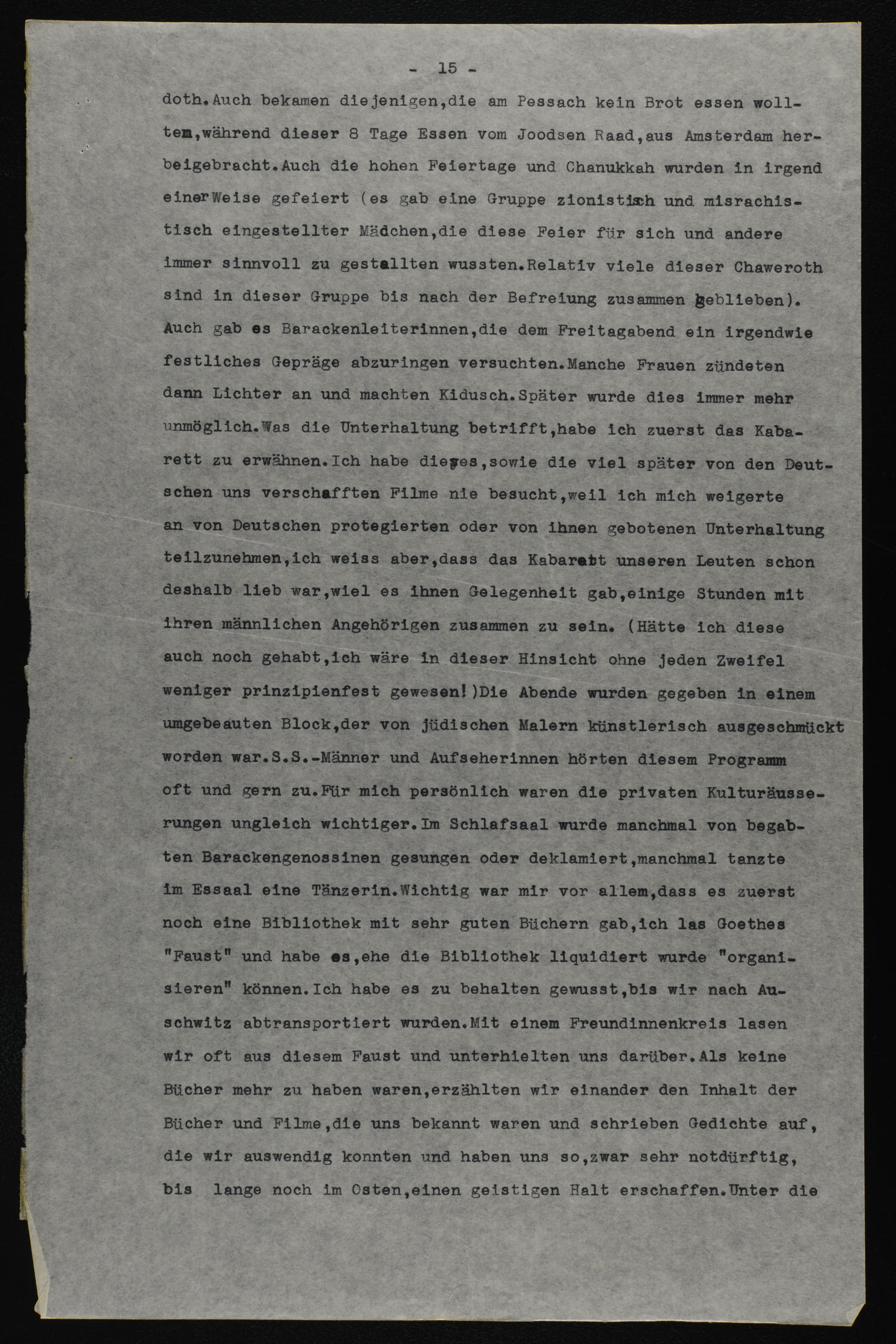
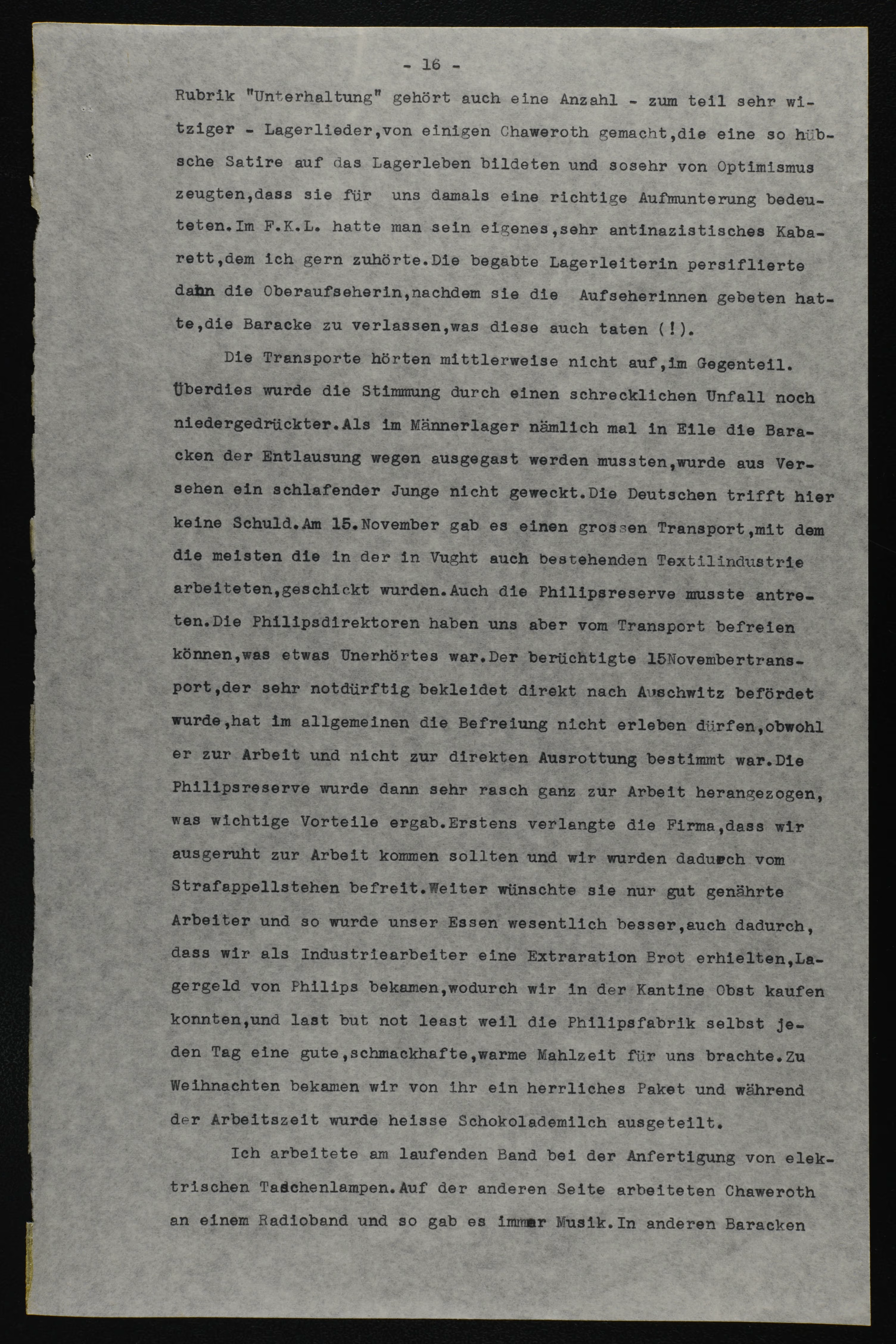
There were still other, smaller bright spots. I mean religion and culture in the broadest sense of the word, which I would also include entertainment this time. Although the percentage of religious people in the camp was naturally no greater than outside, one nevertheless clearly felt their influence, especially in the beginning. I still remember Pesach 1943, when a Seder evening was held, with the necessary Matzoh and Haggadot. Those who did not want to eat bread on Pesach also had food brought from the Joodse Raad from Amsterdam during these 8 days. The High Holy Days and Hanukkah were also celebrated in some way (there was a group of Zionist and Mizrachi-oriented girls who knew how to make this celebration meaningful for themselves and others. A relatively large number of these chaverot [female comrades/friends] remained together in this group until after the liberation). There were also female barrack leaders who tried to give Friday evening a somewhat festive character. Some women then lit candles and made Kiddush. Later, this became increasingly impossible. Regarding entertainment, I must first mention the cabaret. I never attended it, nor the films provided to us much later by the Germans, because I refused to participate in entertainment protected by the Germans or offered by them, but I know that the cabaret was dear to our people precisely because it gave them the opportunity to be together with their male relatives for a few hours. (If I had still had these, I would undoubtedly have been less steadfast in my principles in this regard!). The evenings were given in a rebuilt block that had been artistically decorated by Jewish painters. S.S. men and female guards often and gladly listened to this program. For me personally, the private cultural expressions were infinitely more important. In the dormitory, gifted barrack mates sometimes sang or recited; sometimes a dancer danced in the dining hall. Above all, it was important to me that at first there was still a library with very good books; I read Goethe's "Faust" and managed to "organize" [scrounge/secure] it before the library was liquidated. I managed to keep it until we were transported to Auschwitz. With a circle of friends, we often read from this Faust and discussed it. When no more books were to be had, we told each other the contents of the books and films that we knew and wrote down poems that we knew by heart, thus creating a spiritual anchor for ourselves, albeit a very meager one, until long after we were in the East. Under the heading of "Entertainment" also falls a number of - partly very funny - camp songs, created by some chaverot, which formed such a pretty satire on camp life and testified to so much optimism that they meant real encouragement for us at the time. The F.K.L. had its own, very anti-Nazi cabaret, which I gladly listened to. The gifted female camp leader then parodied the head guard after she had asked the female guards to leave the barrack, which they actually did (!).
The transports, meanwhile, did not stop; on the contrary. Moreover, the mood was depressed even further by a terrible accident. Namely, when the barracks in the men's camp once had to be fumigated in a hurry for delousing, a sleeping boy was accidentally not woken up. The Germans were not to blame here. On November 15 there was a large transport, with which most of those working in the textile industry - which also existed in Vught - were sent. The Philips reserve also had to line up. The Philips directors, however, were able to exempt us from the transport, which was somewhat unheard of. The notorious November 15 transport, which was conveyed directly to Auschwitz very scantily clothed, generally did not live to see the liberation, although it was destined for work and not for direct extermination. The Philips reserve was then very quickly drafted entirely for work, which yielded important advantages. Firstly, the company demanded that we should come to work rested and we were thereby freed from standing for punishment roll calls. Furthermore, they only wanted well-nourished workers, and so our food became significantly better, also because as industrial workers we received an extra ration of bread, got camp money from Philips, which allowed us to buy fruit in the canteen, and last but not least because the Philips factory itself brought a good, tasty, warm meal for us every day. For Christmas we received a wonderful package from them and during working hours hot chocolate milk was distributed.
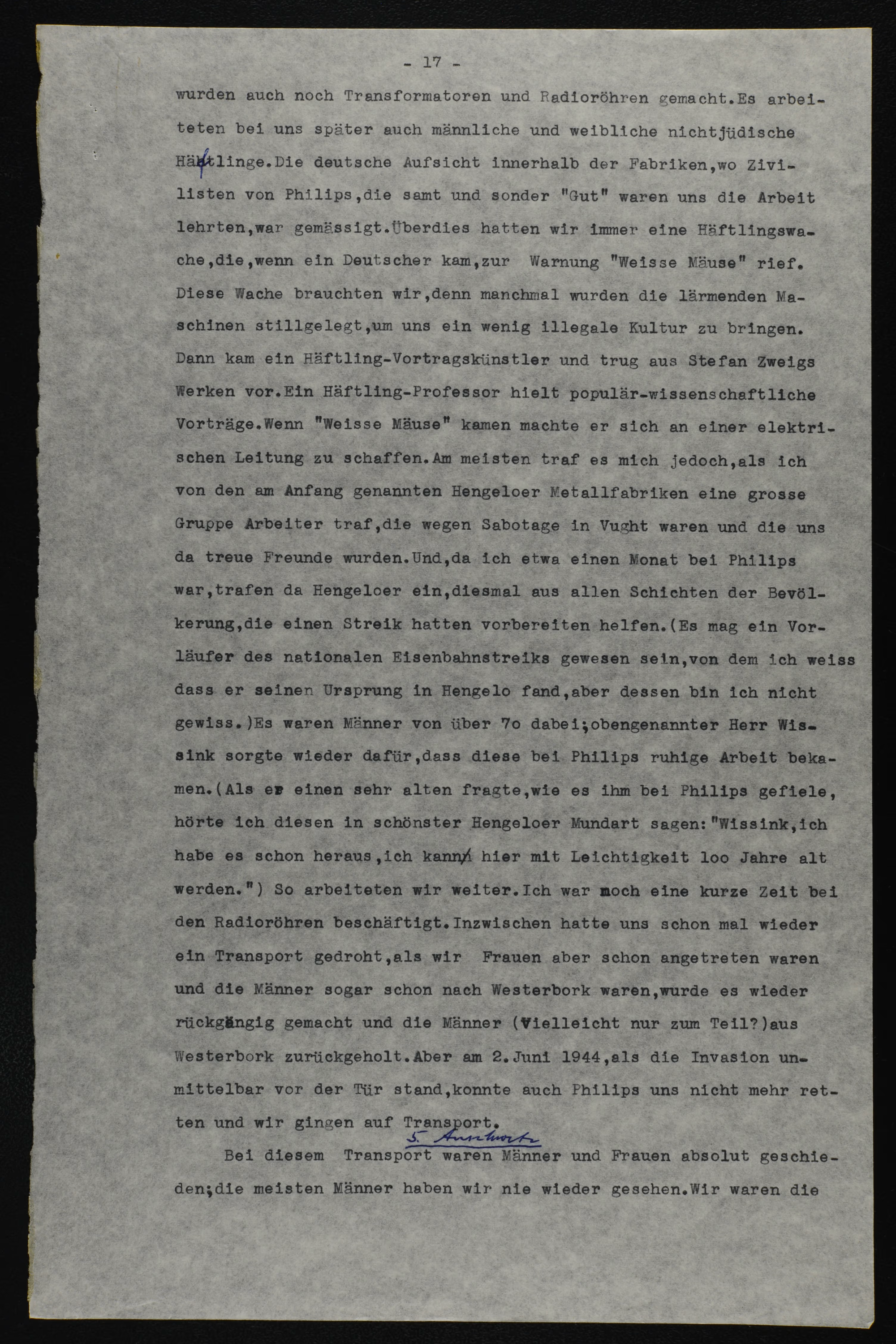
I worked on the assembly line in the production of electric flashlights. On the other side, chaverot worked on a radio line and so there was always music. In other barracks, transformers and radio tubes were also made. Later, male and female non-Jewish prisoners also worked with us. The German supervision within the factories, where civilians from Philips, who were all "good," taught us the work, was moderate. Moreover, we always had a prisoner guard who, when a German came, called out "White Mice" as a warning. We needed this guard, because sometimes the noisy machines were shut down to bring us a little illegal culture. Then a prisoner recital artist came and recited from Stefan Zweig's works. A prisoner professor held popular science lectures. When "White Mice" came, he pretended to work on an electrical line. What struck me the most, however, was when I met a large group of workers from the Hengelo metal factories mentioned at the beginning, who were in Vught because of sabotage and who became our true friends. And since I had been at Philips for about a month, people from Hengelo arrived, this time from all strata of the population, who had helped prepare a strike. (It may have been a precursor to the national railway strike, which I know originated in Hengelo, but of this I am not certain.). There were men over 70 among them; the aforementioned Mr. Wissink again ensured that they got quiet work at Philips. (When he asked a very old man how he liked it at Philips, I heard him say in the most beautiful Hengelo dialect: "Wissink, I've already figured it out, I could easily reach 100 years old here."). So we kept working. I was employed with the radio tubes for a short time. In the meantime, we had been threatened with a transport once again; however, when we women had already lined up and the men were even already on their way to Westerbork, it was reversed again and the men (perhaps only in part?) were brought back from Westerbork. But on June 2, 1944, when the invasion was right at the door, even Philips could no longer save us and we went on the transport.
Auschwitz
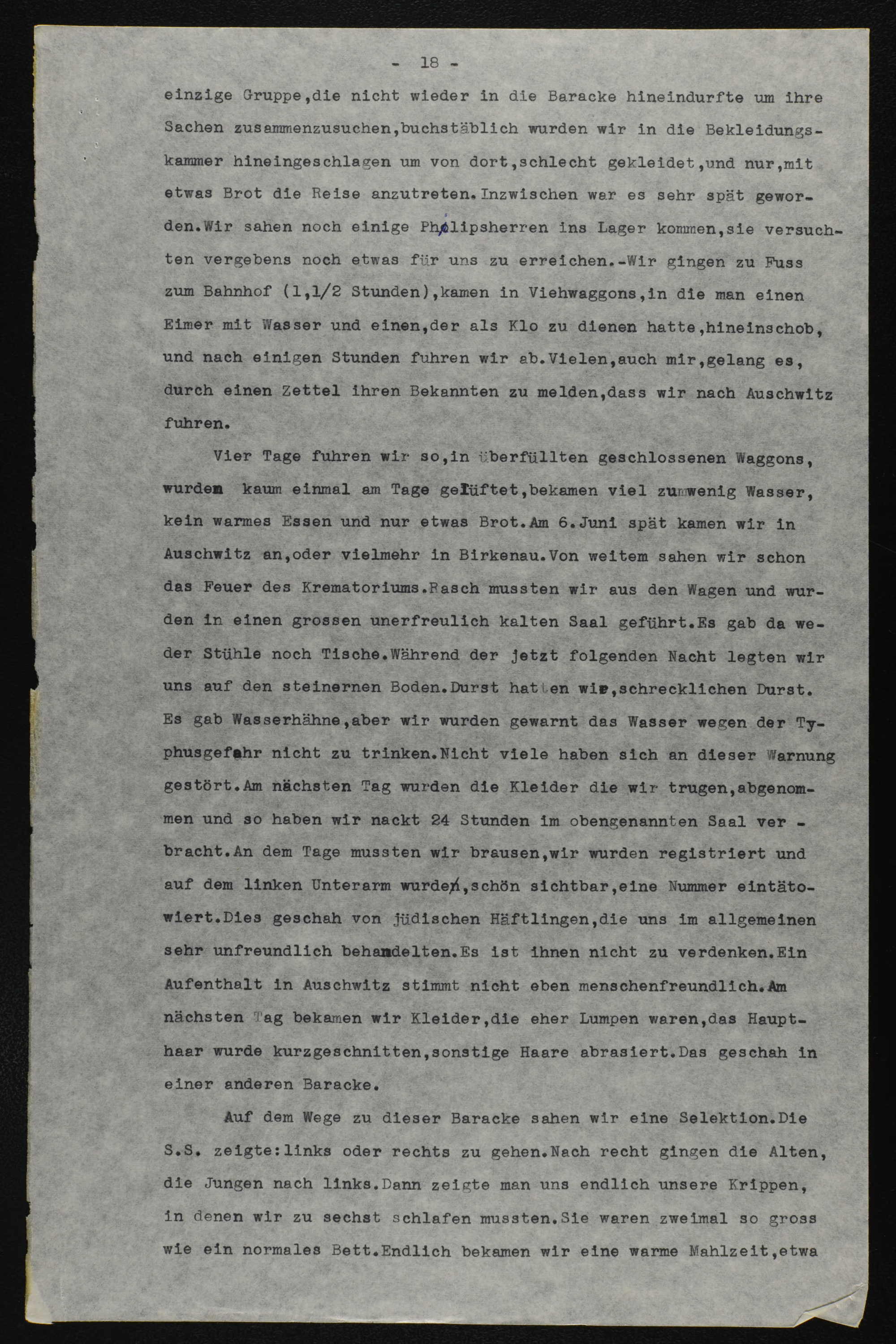
On this transport, men and women were absolutely separated; we never saw most of the men again. We were the only group that was not allowed back into the barrack to gather our things; we were literally beaten into the clothing room to start the journey from there, poorly dressed and only with a little bread. By now it had become very late. We still saw a few Philips gentlemen come into the camp; they tried in vain to achieve something more for us. -We walked to the train station (1.5 hours), were put into cattle cars into which one shoved a bucket with water and one that was to serve as a toilet, and after a few hours we departed. Many, including myself, managed to notify their acquaintances via a slip of paper that we were traveling to Auschwitz.
We traveled like this for four days, in overcrowded closed cars, were barely aired out once a day, received far too little water, no warm food, and only some bread. Late on June 6, we arrived in Auschwitz, or rather in Birkenau. From afar we already saw the fire of the crematorium. We quickly had to get out of the cars and were led into a large, unpleasantly cold hall. There were neither chairs nor tables there. During the night that now followed, we lay down on the stone floor. We were thirsty, terribly thirsty. There were water faucets, but we were warned not to drink the water because of the danger of typhus. Not many people let themselves be bothered by this warning. The next day, the clothes we were wearing were taken away and so we spent 24 hours naked in the aforementioned hall. During the day we had to shower, we were registered, and a number was tattooed on the left forearm, clearly visible. This was done by Jewish prisoners who generally treated us very unpleasantly. One cannot blame them. A stay in Auschwitz doesn't exactly make one misanthropic [Note: contextually means philanthropy/kind-heartedness is lost]. The next day we received clothes that were rather rags; the hair on our heads was cut short, other hair shaved off. This happened in a different barrack.
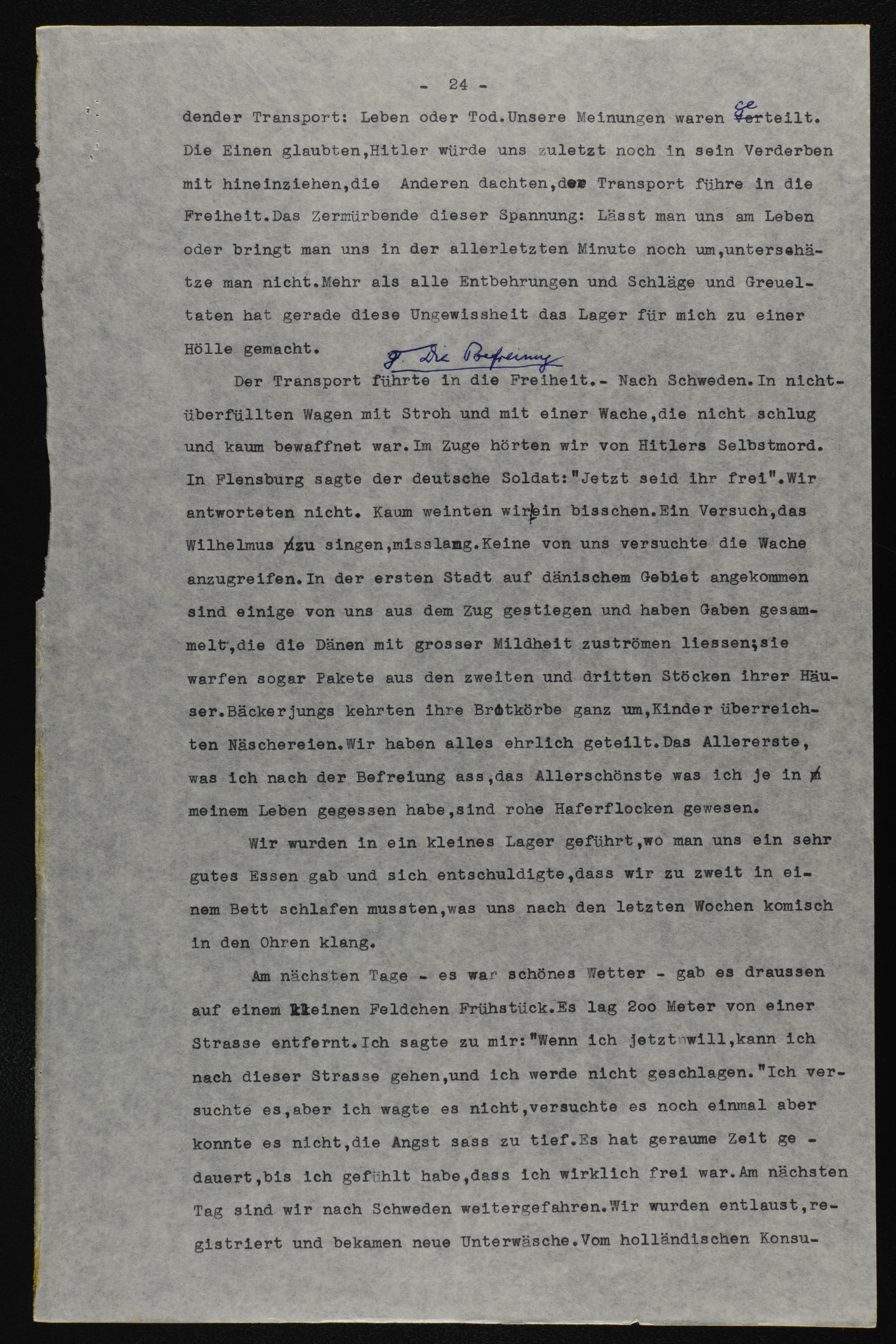
On the way to this barrack we saw a selection. The S.S. indicated: go left or right. The old went to the right, the young to the left. Then we were finally shown our cribs, in which six of us had to sleep. They were twice the size of a normal bed. Finally we received a warm meal, about....
Gedula's Yad Vashem Testimony 19-24
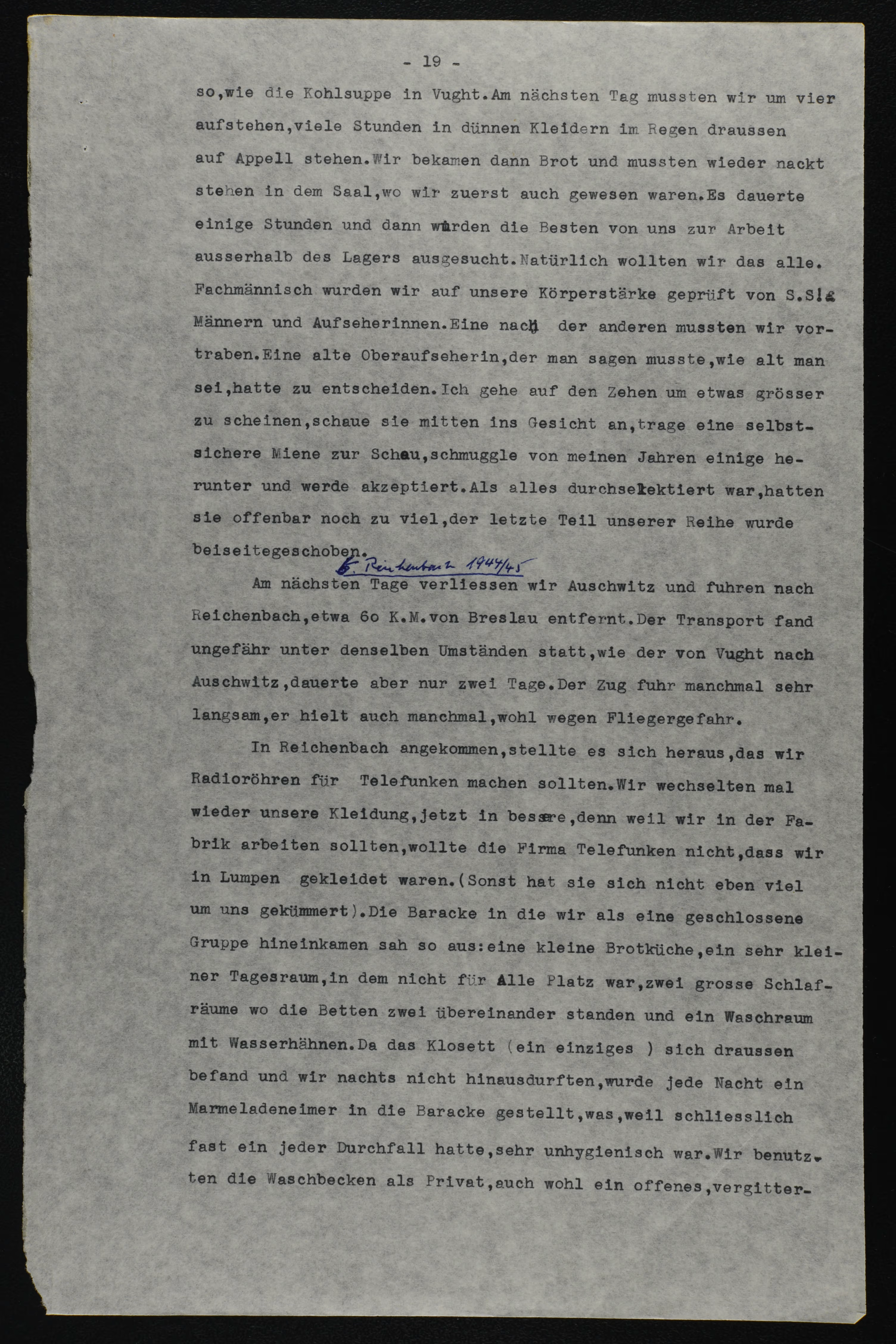
...about the same as the cabbage soup in Vught. The next day we had to get up at four o'clock, stand outside for roll call in the rain for many hours in thin clothes. We then received bread and had to stand naked again in the hall where we had first been. It lasted a few hours and then the best of us were selected for work outside the camp. Naturally, we all wanted that. We were expertly examined for our physical strength by S.S. men and female guards. We had to trot forward one after the other. An old head female guard, to whom you had to declare how old you were, had to decide. I walk on my toes to appear a little taller, look her straight in the face, display a self-assured expression, smuggle a few years off my age, and am accepted. When everything had been sorted through, they apparently still had too many; the last part of our row was pushed aside.
Reichenbach 1944/45
The next day we left Auschwitz and traveled to Reichenbach, about 60 km from Breslau. The transport took place under roughly the same conditions as the one from Vught to Auschwitz, but only lasted two days. The train sometimes traveled very slowly; it also stopped sometimes, probably because of the danger of air raids.
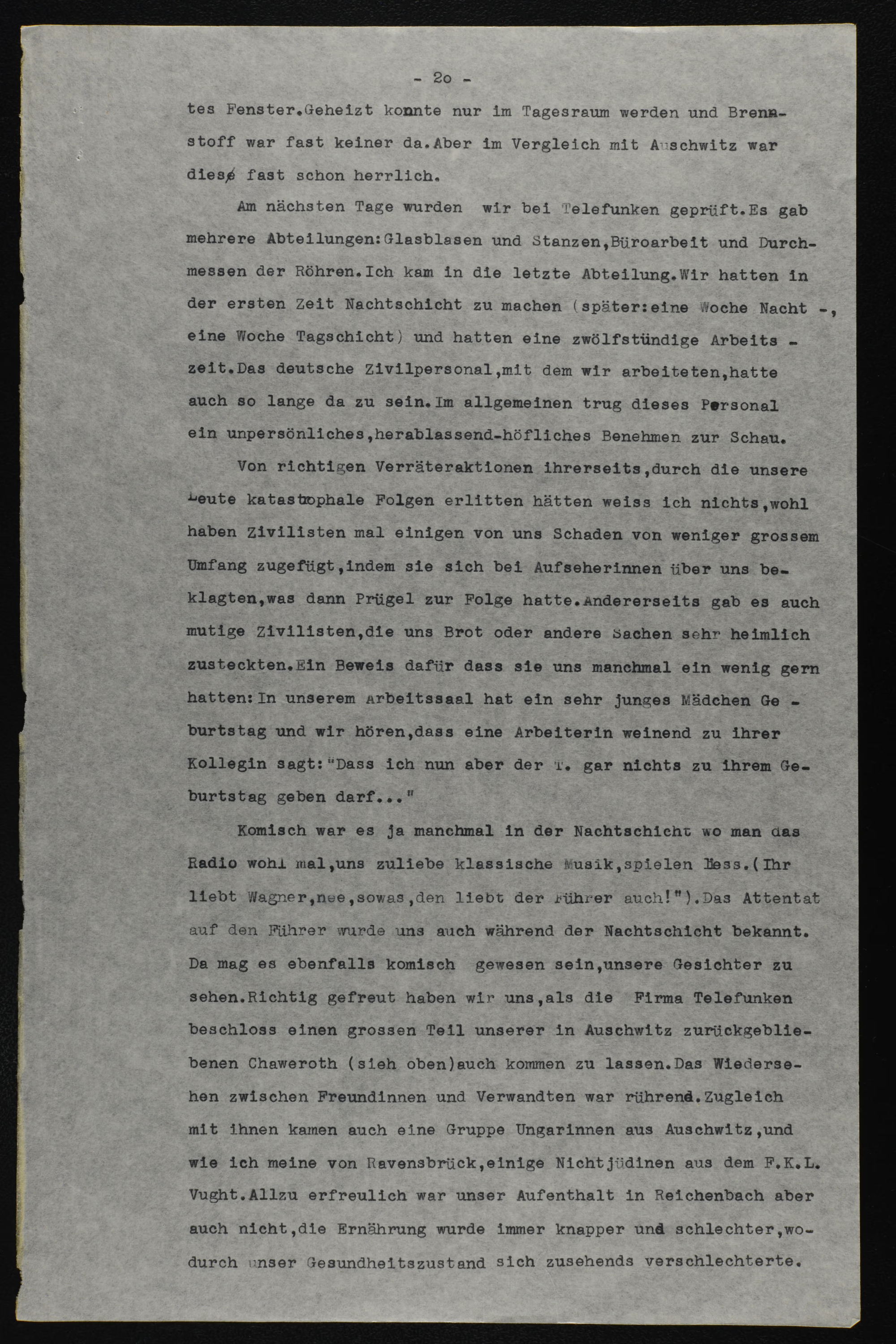
Having arrived in Reichenbach, it turned out that we were to make radio tubes for Telefunken. We changed our clothes once again, now into better ones, because since we were to work in the factory, the Telefunken company did not want us to be dressed in rags. (Otherwise they didn't exactly care much about us). The barrack into which we entered as a closed group looked like this: a small bread kitchen, a very small day room that did not have space for everyone, two large sleeping rooms where the beds stood two on top of each other, and a washroom with water faucets. Since the toilet (a single one) was located outside and we were not allowed out at night, a marmalade bucket was placed in the barrack every night, which, because almost everyone had diarrhea, was very unhygienic. We used the washbasins privately, as well as an open, barred window. Heating was only possible in the day room and there was almost no fuel. But compared to Auschwitz, this was almost glorious.
The next day we were tested at Telefunken. There were several departments: glassblowing and stamping, office work, and measuring the tubes. I ended up in the last department. At first we had to work the night shift (later: one week night, one week day shift) and had a twelve-hour workday. The German civilian personnel we worked with also had to be there that long. In general, this personnel displayed an impersonal, condescendingly polite demeanor.
I know nothing of real acts of betrayal on their part through which our people would have suffered catastrophic consequences; civilians probably did sometimes cause some of us harm of a lesser scale by complaining about us to female guards, which then resulted in beatings. On the other hand, there were also brave civilians who very secretly slipped us bread or other things. A proof that they sometimes liked us a little: In our workroom, a very young girl has a birthday and we hear a worker say crying to her colleague: "But that I am not allowed to give her anything at all for her birthday now...".
It was indeed funny sometimes during the night shift when the radio was allowed to play classical music for our sake. ("You love Wagner, no, something like that, the Führer loves that too!"). The assassination attempt on the Führer also became known to us during the night shift. It must have been equally funny to see our faces then. We were truly delighted when the Telefunken company decided to also have a large portion of our chaverot who had remained in Auschwitz (see above) come. The reunion between friends and relatives was touching. Together with them also came a group of Hungarian women from Auschwitz, and as I recall from Ravensbrück, some non-Jews from the F.K.L. Vught. However, our stay in Reichenbach was not overly pleasant either; the food became increasingly scarce and worse, which caused our state of health to visibly deteriorate.
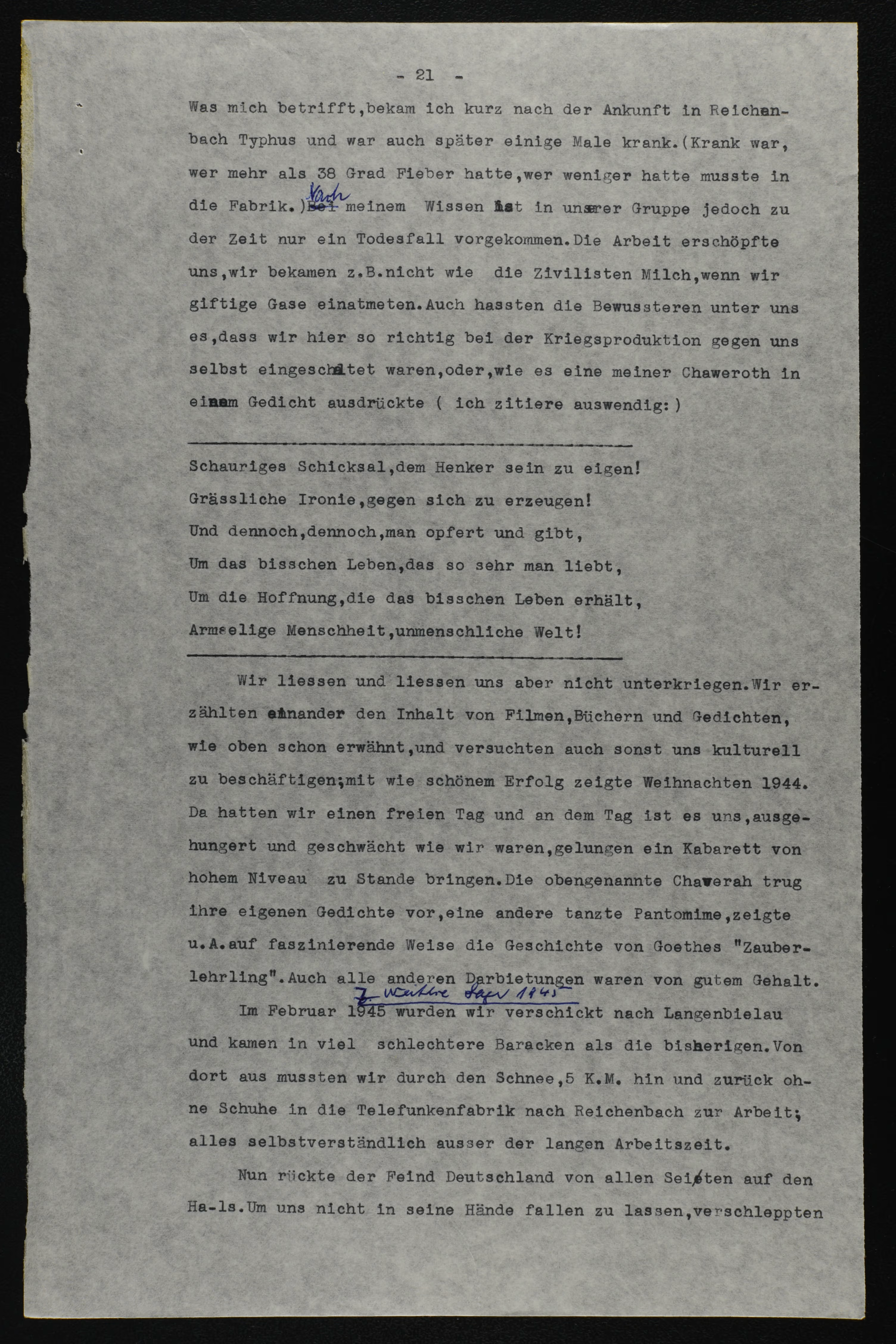
As for me, I got typhus shortly after arriving in Reichenbach and was also sick a few times later. (Sick meant anyone who had a fever over 38 degrees; whoever had less had to go to the factory.). To my knowledge, however, there was only one death in our group at that time. The work exhausted us; we did not receive milk like the civilians did when we inhaled toxic gases, for example. The more conscious among us also hated that we were so fully engaged in war production against ourselves here, or, as one of my chaverot expressed it in a poem (I quote from memory:)
Gruesome fate, to be one's own executioner!
Hideous irony, to produce against oneself!
And yet, and yet, one sacrifices and gives,
For the bit of life that one loves so much,
For the hope that sustains the bit of life,
Pitiful humanity, inhuman world!
But we did not let ourselves be defeated. We told each other the contents of films, books, and poems, as already mentioned above, and otherwise also tried to keep ourselves culturally occupied; Christmas 1944 showed with what beautiful success. We had a day off then, and on that day, as starved and weakened as we were, we managed to put on a cabaret of a high standard. The aforementioned chaverah recited her own poems, another danced pantomime, demonstrating among other things the story of Goethe's "Sorcerer's Apprentice" in a fascinating way. All other performances were also of good substance.
Other Camps 1945
In February 1945 we were sent to Langenbielau and ended up in much worse barracks than the previous ones. From there we had to walk 5 km back and forth through the snow without shoes to the Telefunken factory in Reichenbach for work; all this naturally on top of the long working hours.
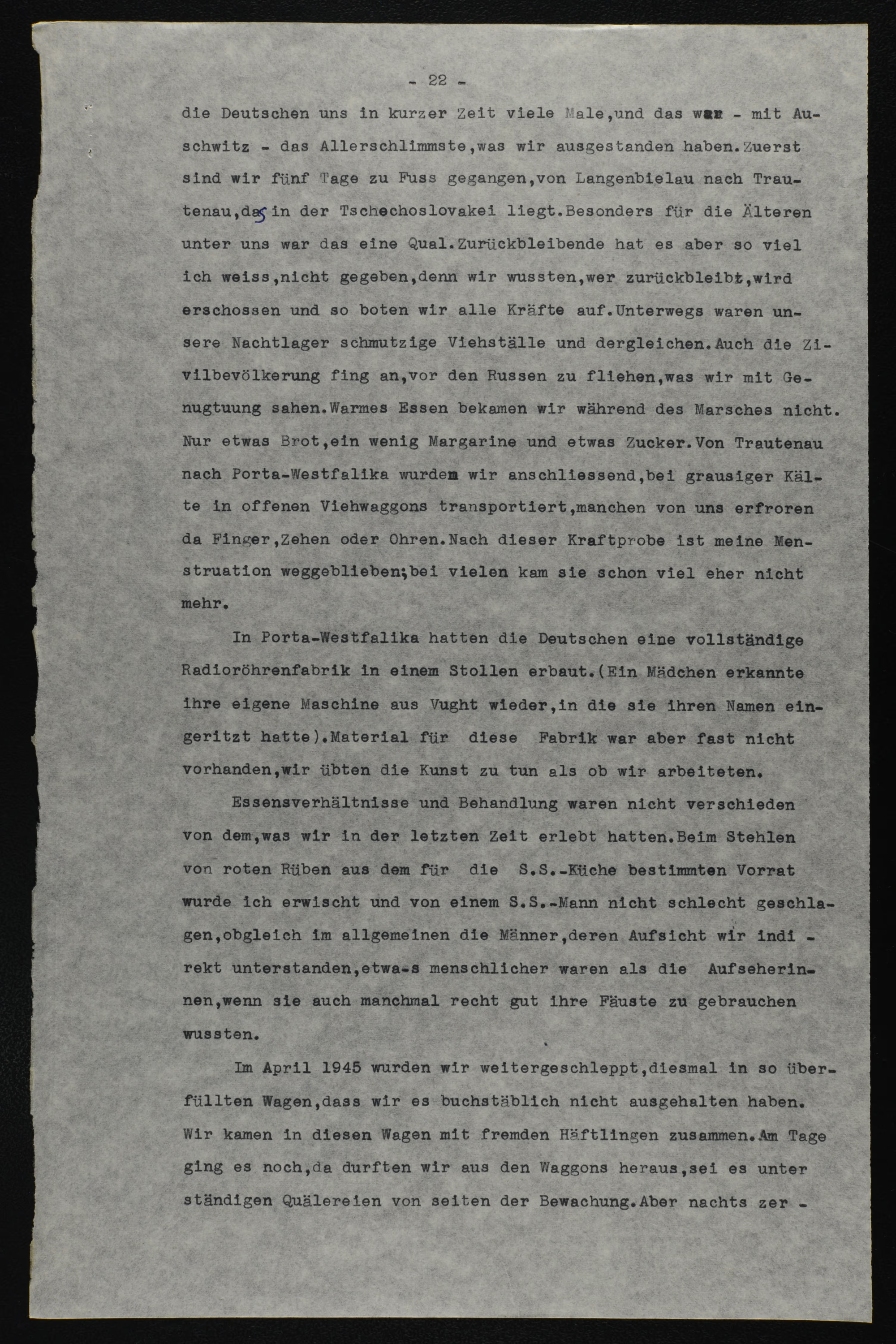
Now the enemy was advancing on Germany from all sides. To prevent us from falling into his hands, the Germans dragged us away many times in a short period, and that was - along with Auschwitz - the absolute worst thing we endured. First we walked for five days from Langenbielau to Trautenau, which lies in Czechoslovakia. Especially for the older ones among us, this was an agony. However, as far as I know, there were no stragglers, because we knew that whoever stayed behind would be shot, and so we mustered all our strength. Along the way, our night camps were dirty cattle stalls and the like. The civilian population also began to flee from the Russians, which we saw with satisfaction. We received no warm food during the march. Only some bread, a little margarine, and some sugar. From Trautenau to Porta-Westfalica we were subsequently transported in open cattle cars in gruesome cold; some of us suffered frostbite on fingers, toes, or ears there. After this test of strength, my menstruation stopped; for many, it had already stopped much earlier.
In Porta-Westfalica, the Germans had built a complete radio tube factory in a tunnel. (A girl recognized her own machine from Vught, into which she had carved her name). However, there was almost no material for this factory; we practiced the art of pretending to work.
Food conditions and treatment were no different from what we had experienced recently. I was caught stealing beets from the stock intended for the S.S. kitchen and was beaten quite badly by an S.S. man, although in general the men to whose supervision we were indirectly subordinate were somewhat more humane than the female guards, even if they too sometimes knew quite well how to use their fists.
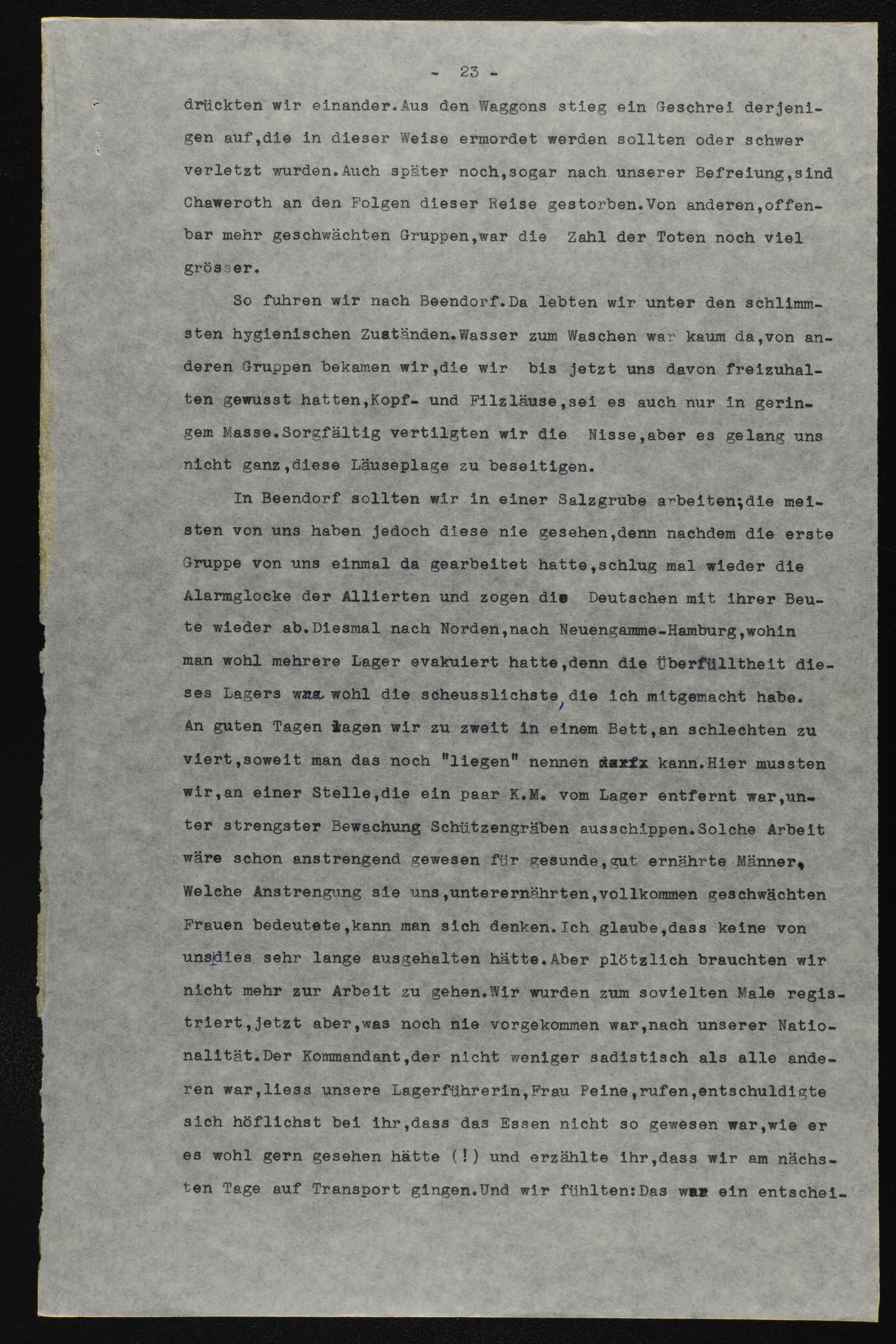
In April 1945 we were dragged further, this time in cars so overcrowded that we literally couldn't bear it. We came together in these cars with strange prisoners. During the day it was still manageable, since we were allowed out of the railcars, albeit under constant torment from the guards. But at night we crushed one another. Cries rose from the cars from those who were going to be murdered in this way or were severely injured. Even later, even after our liberation, chaverot died from the consequences of this journey. For other, apparently more weakened groups, the number of dead was much greater still.
So we traveled to Beendorf. There we lived under the worst hygienic conditions. There was barely any water for washing; from other groups we contracted head and pubic lice, which we had managed to keep clear of until now, even if only to a small degree. We carefully exterminated the nits, but we did not entirely succeed in eliminating this lice plague.
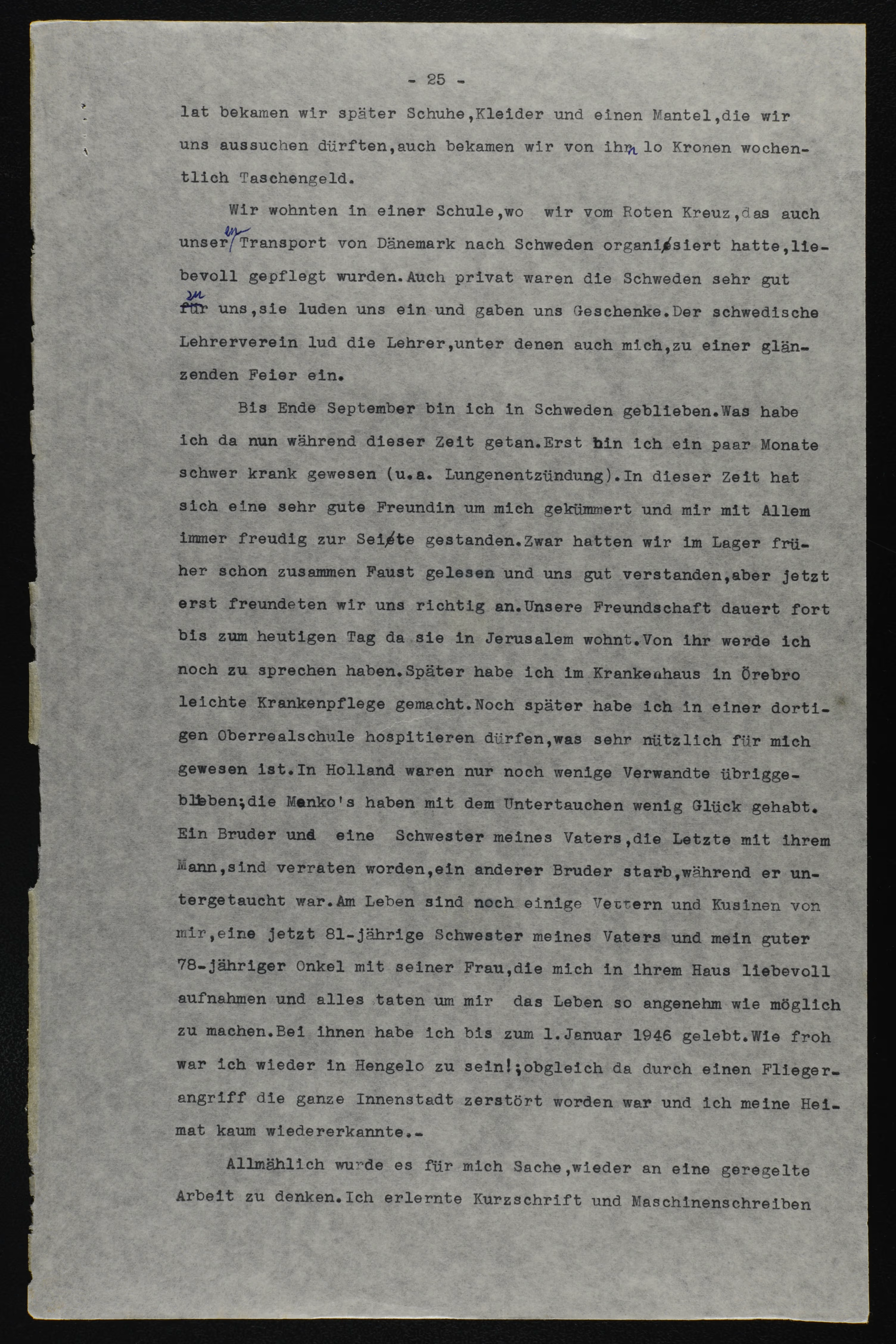
In Beendorf we were supposed to work in a salt mine; however, most of us never saw it, because after the first group of us had worked there once, the alarm bell of the Allies sounded again and the Germans withdrew once more with their loot. This time to the north, to Neuengamme-Hamburg, where several camps had probably been evacuated, because the overcrowding of this camp was probably the most hideous I have experienced. On good days we lay two to a bed, on bad days four, as far as you can still call that "lying". Here we had to shovel trenches at a site a few kilometers from the camp under the strictest guard. Such work would have already been exhausting for healthy, well-nourished men. What exertion it meant for us, undernourished, completely weakened women, one can imagine. I believe that none of us would have endured this for very long. But suddenly we no longer had to go to work. We were registered for the umpteenth time, but now, which had never happened before, by our nationality. The commandant, who was no less sadistic than all the others, had our camp leader, Mrs. Peine, called, apologized to her politely that the food had not been as he would have liked to see it (!), and told her that we were going on transport the next day. And we felt: This was a decisive transport: life or death. Our opinions were divided. Some believed Hitler would drag us down into his ruin at the very end; others thought the transport would lead to freedom. One shouldn't underestimate the grueling nature of this tension: will they let us live or will they kill us at the very last minute. More than all the deprivations and beatings and atrocities, it was precisely this uncertainty that made the camp a hell for me.
The Liberation
The transport led to freedom. - To Sweden. In uncrowded cars with straw and with a guard who didn't beat us and was barely armed. On the train we heard of Hitler's suicide. In Flensburg, the German soldier said: "Now you are free.". We did not answer. We barely cried a little. An attempt to sing the Wilhelmus failed. None of us attempted to attack the guard. Having arrived in the first city on Danish territory, some of us got off the train and gathered gifts that the Danes let flow in with great gentleness; they even threw packages from the second and third floors of their houses. Baker's boys completely emptied their bread baskets, children handed over sweets. We shared everything honestly. The very first thing I ate after the liberation, the most beautiful thing I have ever eaten in my life, was raw oatmeal.
We were led into a small camp, where we were given a very good meal and they apologized that we had to sleep two to a bed, which sounded funny to our ears after the last few weeks.
The next day - the weather was beautiful - there was breakfast outside on a small field. It lay 200 meters from a road. I said to myself: "If I want to now, I can walk to this road, and I will not be beaten.". I tried it, but I didn't dare, tried it again but couldn't, the fear sat too deep. It took a considerable amount of time before I felt that I was truly free. The next day we traveled on to Sweden. We were deloused, registered and received new underwear. From the Dutch consulate...
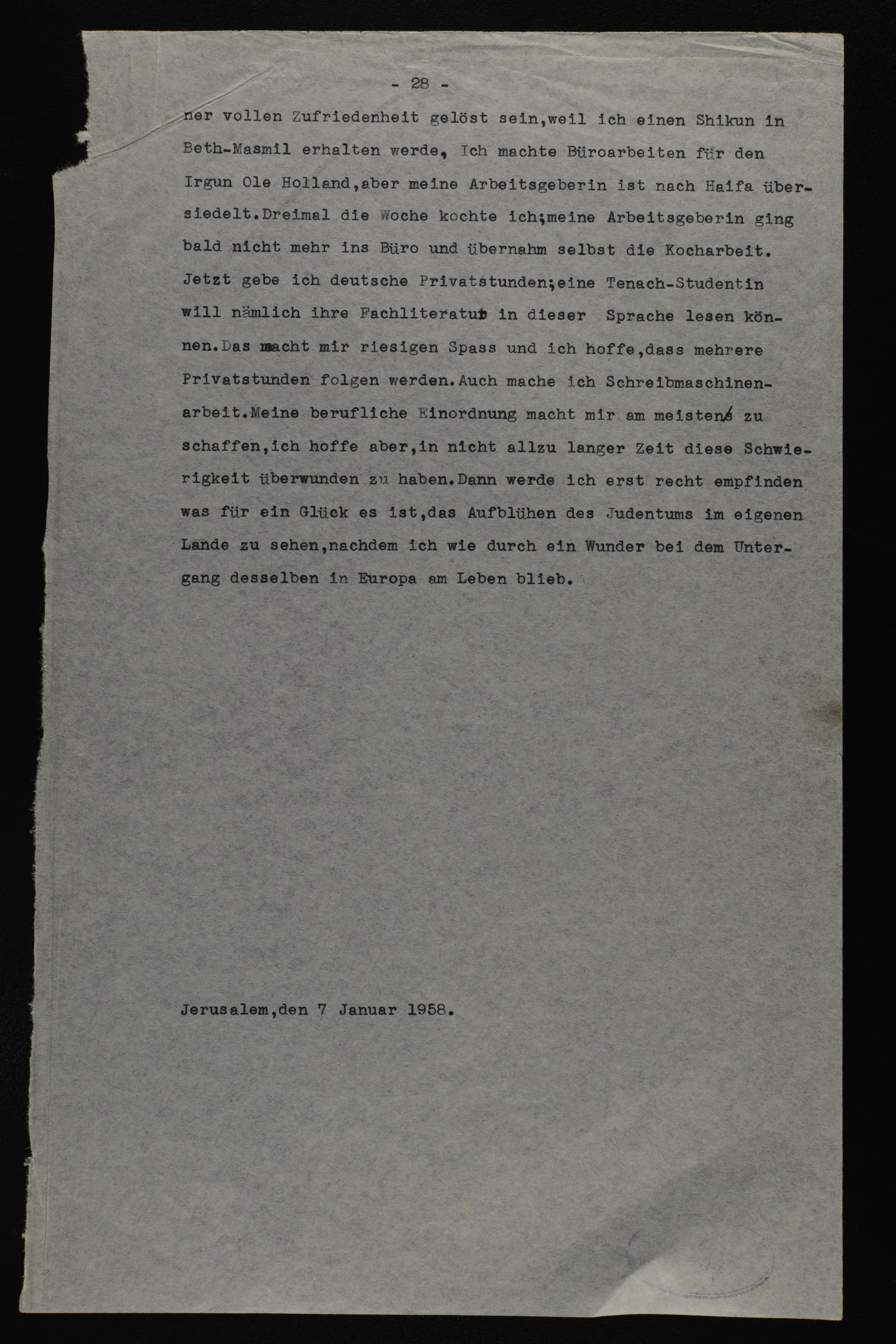
Gedula's Yad Vashem Testimony 25-28
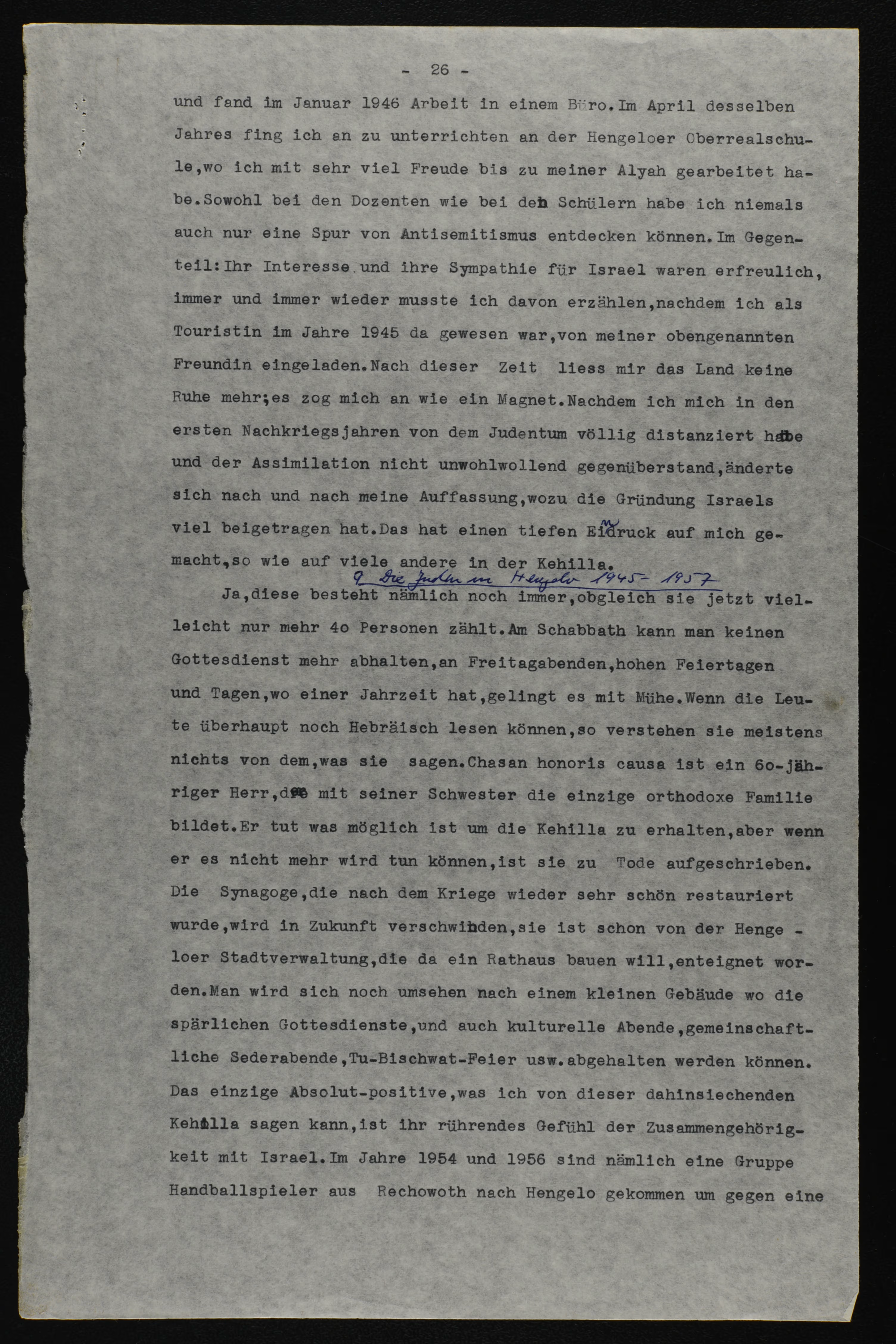
... we later received shoes, dresses, and a coat, which we were allowed to pick out ourselves, and we also received 10 crowns of pocket money weekly from him.
We lived in a school, where we were lovingly cared for by the Red Cross, which had also organized our transport from Denmark to Sweden. Privately, too, the Swedes were very good to us; they invited us and gave us gifts. The Swedish teachers' association invited the teachers, among them myself, to a brilliant celebration.
I stayed in Sweden until the end of September. What did I do there during this time. First, I was seriously ill for a few months (among other things, pneumonia). During this time, a very good friend took care of me and always joyfully stood by my side with everything. True, we had already read "Faust" together in the camp earlier and got along well, but only now did we really become friends. Our friendship continues to this day since she lives in Jerusalem. I will have more to speak of her. Later I did light nursing at the hospital in Örebro. Even later I was allowed to sit in as a guest auditor at a secondary school there, which was very useful for me. In Holland, only a few relatives were left; the Menkos had little luck with going into hiding. A brother and a sister of my father, the latter with her husband, were betrayed; another brother died while he was in hiding. Still alive are some cousins of mine, a now 81-year-old sister of my father, and my good 78-year-old uncle with his wife, who lovingly took me into their home and did everything to make life as pleasant as possible for me. I lived with them until January 1, 1946. How glad I was to be in Hengelo again!; although the entire city center had been destroyed by an air raid and I hardly recognized my hometown anymore.
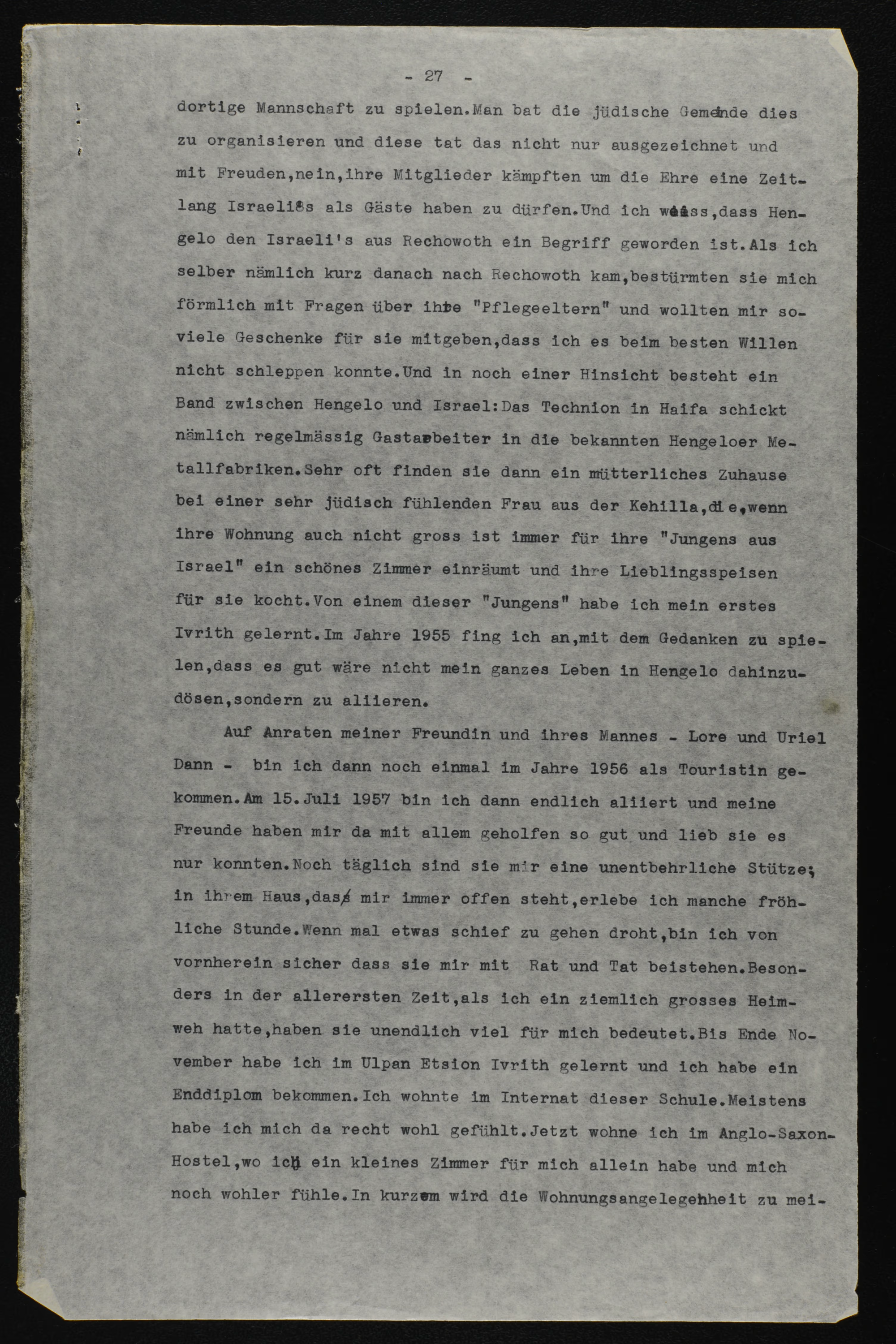
Gradually it became a matter for me to think about regular work again. I learned shorthand and typing and found work in an office in January 1946. In April of the same year, I started teaching at the Hengelo secondary school, where I worked with a great deal of joy until my Aliyah. Both among the lecturers and among the students, I was never able to discover even a trace of antisemitism. On the contrary: their interest and their sympathy for Israel were delightful; time and again I had to tell about it after I had been there as a tourist in the year 1955, invited by my aforementioned friend. After this time, the country gave me no peace; it attracted me like a magnet. After having completely distanced myself from Judaism in the first post-war years and not being unfavorably disposed towards assimilation, my attitude gradually changed, to which the founding of Israel contributed a lot. This made a deep impression on me, as it did on many others in the Kehilla.
The Jews in Hengelo 1945-1957
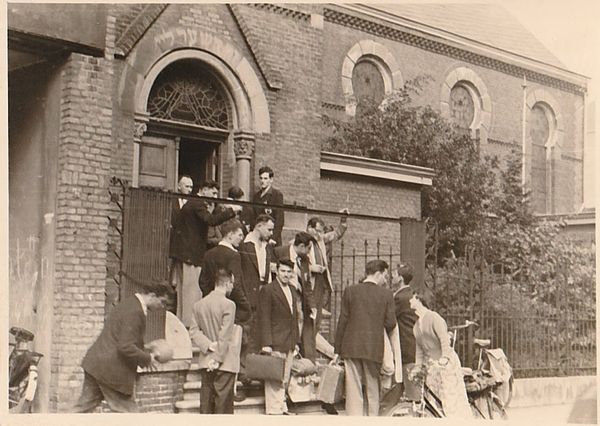
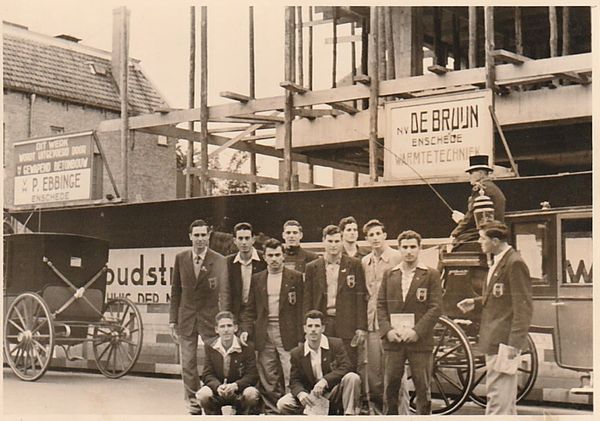
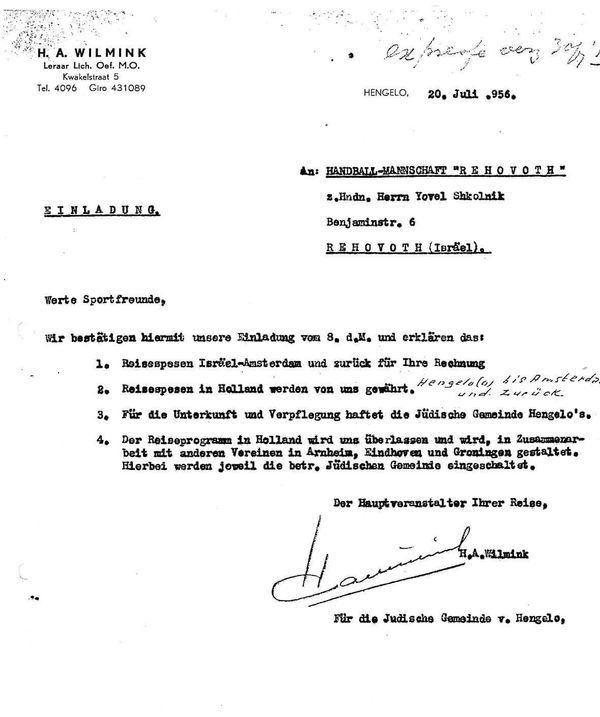
Yes, this [the Kehilla] indeed still exists, although it now numbers perhaps only 40 people. On Shabbat, one can no longer hold a service; on Friday evenings, High Holy Days, and days when someone has a Yahrzeit, it succeeds with effort. If the people can still read Hebrew at all, they mostly understand nothing of what they are saying. Chazzan honoris causa is a 60-year-old gentleman who, with his sister, forms the only orthodox family. He does what is possible to preserve the Kehilla, but when he is no longer able to do it, it is doomed to die. The synagogue, which was restored very beautifully after the war, will disappear in the future; it has already been expropriated by the Hengelo city administration, which wants to build a town hall there. People will still look around for a small building where the sparse services, and also cultural evenings, communal Seder evenings, Tu Bishvat celebrations, etc., can be held. The only absolutely positive thing I can say about this languishing Kehilla is its touching feeling of solidarity with Israel. Namely, in the years 1954 and 1956, a group of handball players from Rehovot came to Hengelo to play against a local team there. The Jewish community was asked to organize this, and it did so not only excellently and with joy, no, its members fought for the honor of being allowed to have Israelis as guests for a while. And I know that Hengelo has become a household name to the Israelis from Rehovot. When I myself came to Rehovot shortly thereafter, they literally bombarded me with questions about their "foster parents" and wanted to give me so many gifts to take back to them that with the best will in the world I couldn't carry them. And in yet another respect, a bond exists between Hengelo and Israel: The Technion in Haifa namely regularly sends guest workers to the well-known Hengelo metal factories. Very often they then find a motherly home with a very Jewish-feeling woman from the Kehilla, who, even if her apartment is not large, always clears a nice room for her "boys from Israel" and cooks their favorite dishes for them. From one of these "boys" I learned my first Hebrew [Ivrith]. In 1955 I began to play with the thought that it would be good not to doze away my whole life in Hengelo, but to make Aliyah.
On the advice of my friend and her husband - Lore and Uriel Dann - I then came once again in the year 1956 as a tourist. On July 15, 1957, I finally made Aliyah, and my friends helped me with everything as well and lovingly as they possibly could. Still daily they are an indispensable support to me; in their house, which is always open to me, I experience many a cheerful hour. If something ever threatens to go wrong, I am certain from the start that they will assist me with words and deeds. Especially in the very beginning, when I was quite homesick, they meant an infinite amount to me. Until the end of November, I learned Hebrew in the Ulpan Etsion and I received a final diploma. I lived in the boarding house of this school. Mostly I felt quite comfortable there. Now I live in the Anglo-Saxon Hostel, where I have a small room all to myself and feel even more comfortable. Shortly, the housing matter will be solved to my full satisfaction, because I will receive a Shikun in Beth-Masmil. I did office work for the Irgun Ole Holland, but my employer relocated to Haifa. Three times a week I cooked; my employer soon no longer went to the office and took over the cooking herself. Now I give private German lessons; a Tanakh student namely wants to be able to read her specialized literature in this language. This is huge fun for me and I hope that more private lessons will follow. I also do typing work. My professional integration gives me the most trouble, but I hope to have overcome this difficulty in not too long a time. Then I will truly feel what a blessing it is to see the flourishing of Judaism in its own country, after I remained alive as if by a miracle during its destruction in Europe.
Jerusalem, January 7, 1958.
The places described in the testimony are marked on the map. Press the enlarge button in the top right corner to view the map in detail in a separate window. Gedulla's journey is divided into four different layers:
- The Netherlands (Hiding & Transit)
- Hengelo ➔ Amsterdam ➔ Santpoort ➔ Hengelo ➔ Vught
- Domestic displacement across the Netherlands, shifting from the eastern border (Hengelo) to the western coast (Amsterdam/Santpoort) and finally south to the Vught transit/concentration camp.
- Eastern Europe (Extermination & Slave Labor)
- Vught ➔ Auschwitz (Poland) ➔ Reichenbach (Germany, now Poland) ➔ Langenbielau (Germany, now Poland)
- A massive deportation eastward into occupied Poland for extermination, followed by a transfer back west for slave labor in the German (now Polish) Silesia region.
- The Death Marches (Retreat into Germany)
- Langenbielau ➔ Trautenau (Czechia) ➔ Porta-Westfalica (Germany) ➔ Beendorf (Germany) ➔ Neuengamme (Germany)
- A chaotic, multi-directional retreat pushed by the advancing Soviet army, moving south into Czechoslovakia on foot, then transported deep into western and northern Germany.
- Liberation
- Neuengamme ➔ Flensburg (Germany) ➔ Örebro (Sweden)➔ Hengelo
- The final rescue transport traveled directly north out of Germany, crossing the Danish border and continuing into neutral Sweden for medical recovery.
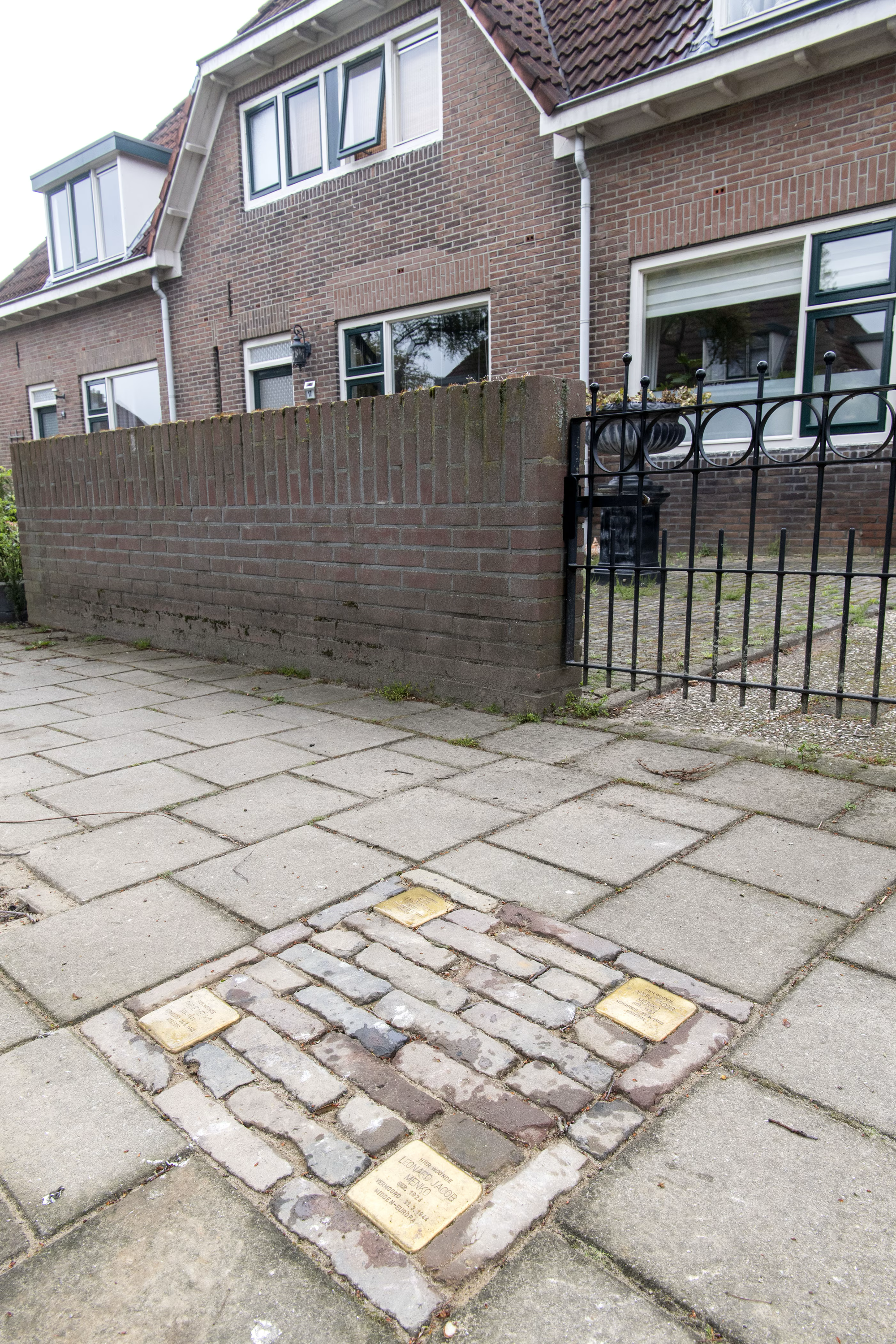
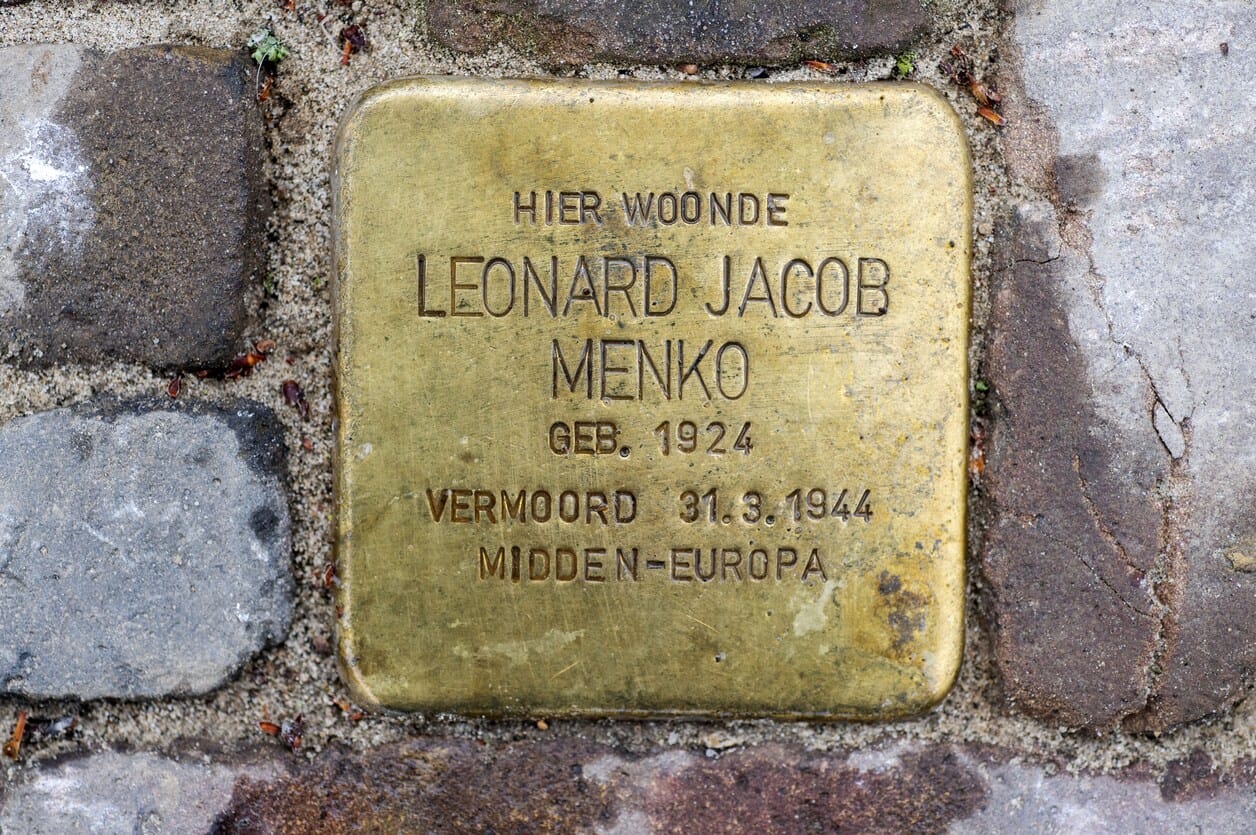
Four stumbling stones (Stolpersteine) on Annastraat in Hengelo, placed in memory of the Menko family (left). A closer look at the stone dedicated to Gedulla's younger brother (right). (Credit: De Stentor)
On Friday, April 29, 2021, the mayor of Hengelo unveiled four Stolpersteine (stumbling stones) in memory of Gedulla's family. The stones commemorate her father, Aron Jacob (1882); her mother, Alida (1882); and her two siblings, Fiene (1923) and Leonard Jacob (1924). The newspaper De Stentor covered the event, publishing an article that detailed the unveiling and explored Gedulla's journey through the lens of her Yad Vashem testimony.
Because this post has become quite long, I will share the remaining information in a future update.
Leave a Comment
Do you recognize a player, a location, or have a story about this tour? Please share your knowledge below. You can comment using just a nickname—no account required.