
Paying respect at the Emergency War Monument in Hengelo
The day after their match, the Rehovot delegation visited the Emergency War Monument to pay their respect. This post details the history of the memorial, and its eventual relocation to the Town Hall square in 1965.
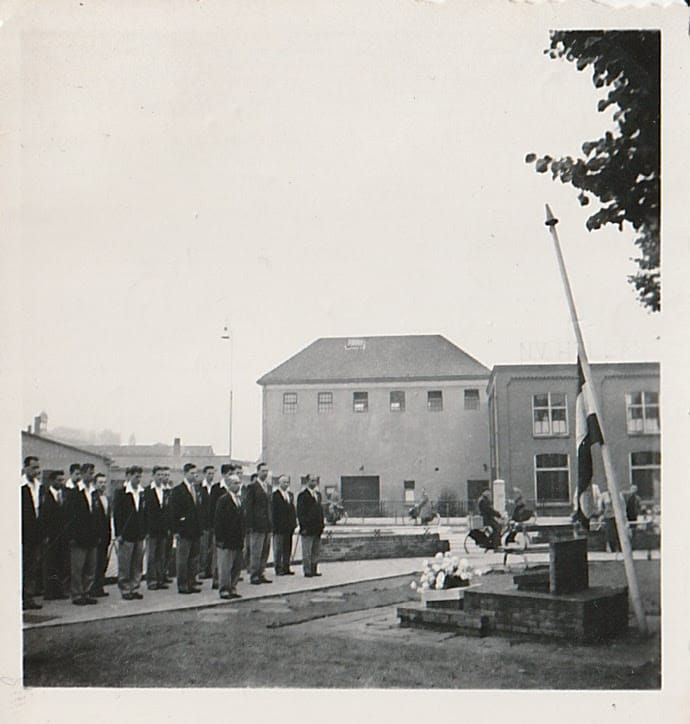
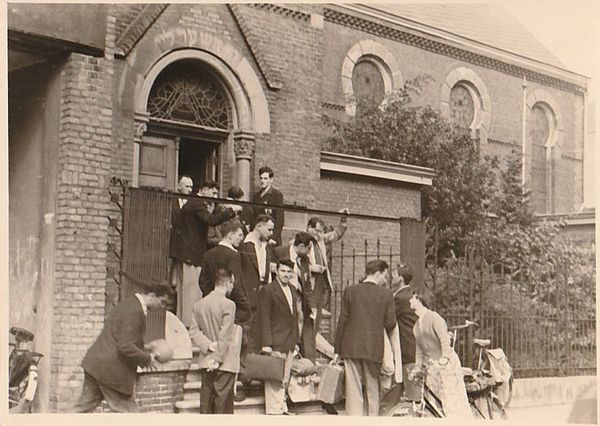
The day after their match, on September 10, 1956, the Rehovot delegation paid tribute to the anonymous Dutch civilians and resistance fighters who fell in World War II. The ceremony was held at the Emergency War Monument (Het Noodmonument), located at the former Cloister Court on historic Thiemsburg street. The monument stood less than 500 meters from the Hengelo synagogue, which just three days earlier had hosted the delegation for the Rosh Hashanah holiday.
The building behind the team was the Kloosterhof (Cloister Court), a Roman Catholic monastery building constructed around the turn of the 20th century to serve the local parish and its adjacent Catholic girls' school. Miraculously surviving the severe Allied air raids that flattened much of central Hengelo during World War II, its quiet, intact backyard garden was chosen as the site to house the city's temporary Emergency War Monument. The structure remained a standing wartime survivor until the early 1960s, when it was demolished as part of a major post-war municipal modernization plan.
One month after the German invasion in May 1940, the captured Dutch soldiers had been released, on the condition that they would not resist the occupying forces. However, the Nazis discovered that many soldiers had become members of the Ordedienst, a resistance group. In April 1943 the Nazis decided to summon the soldiers for forced labor (Arbeitseinsatz). In an attempt to change that decision, the employees of the Stork machine factory in Hengelo went on strike. The strike quickly spread to other parts of the Netherlands. Using extreme violence, the Germans managed to put an end to the strike. Many were arrested and sent for forced labor in the Neuengamme Concentration Camp in northern Germany. Approximately 7,000 Dutch citizens were imprisoned there and the majority did not survive the murderous conditions.
Immediately after the war, the 'emergency monument' was constructed in the form of a burial vault. An urn containing human ashes from the Neuengamme concentration camp was placed in this burial vault. The monument contained two plaques, for all those who fell in the Netherlands, and for all those who fell in the Dutch East Indies. Work on the permanent monument started in 1949, and the new monument was unveiled on April 3, 1965. It is located outside the Town Hall, at Burgemeester Jansenplein 1, where the Neuengamme urn rests permanently beneath its central fountain.
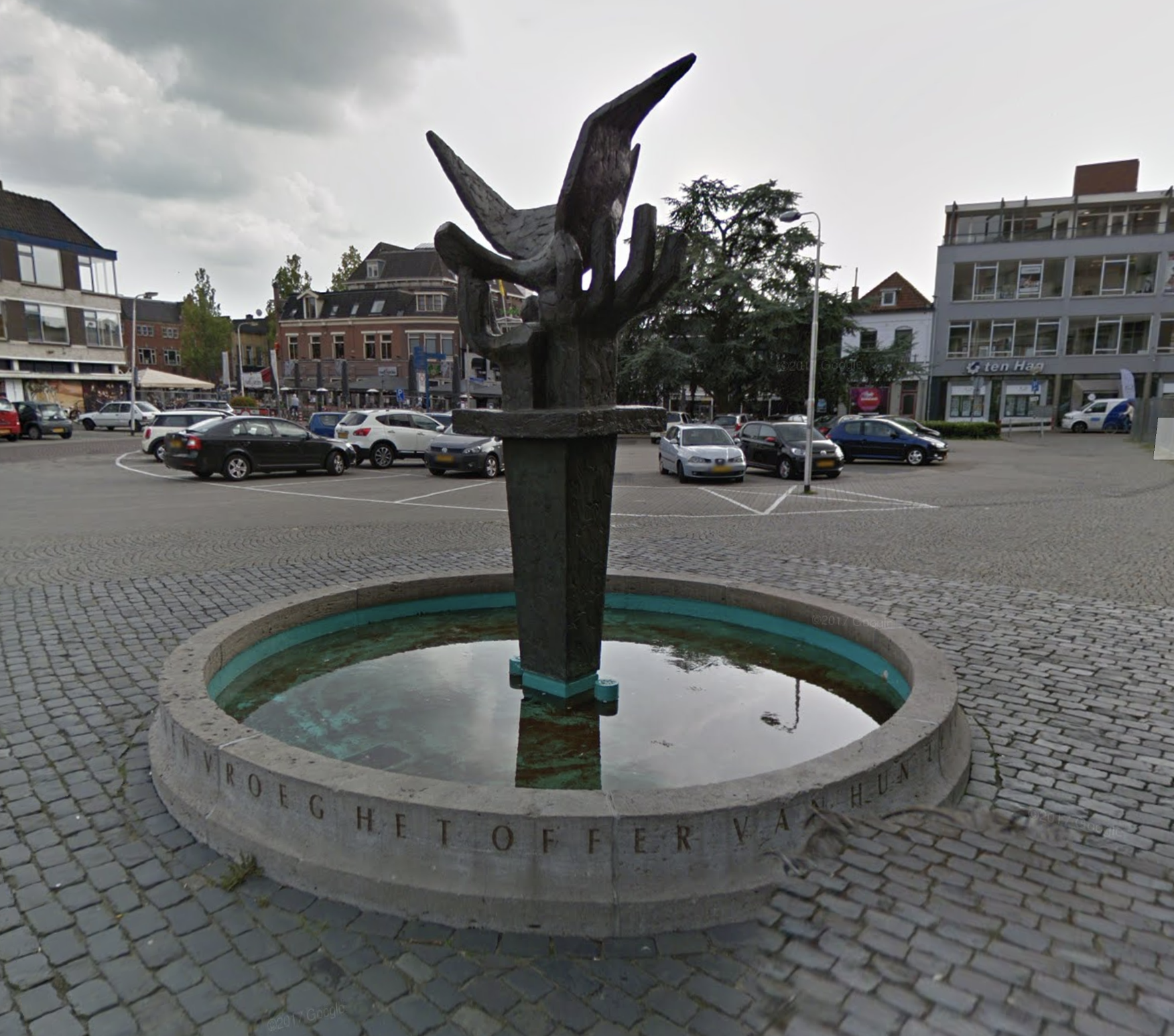
References: The April-May strikes, City Hall Liberation Monument
Leave a Comment
Do you recognize a player, a location, or have a story about this tour? Please share your knowledge below. You can comment using just a nickname—no account required.